

From deposit to dispute, tenant-landlord fault lines are reshaping the rental marketAt the heart of these conflicts is the size of the security deposit and the uncertainty over how much of it will be returned ultimately.
“Renting is fine until you vacate, that’s when the real headaches begin,” one tenant summed it up bluntly. “I paid a ₹70,000 deposit and got back just ₹18,000.” On paper, renting a home is a simple exchange: money for space, trust for time. In reality, practices vary sharply across cities. Nowhere is this more evident than in Bengaluru, where renting has increasingly become a negotiation shaped by precaution and, often, post-exit friction.
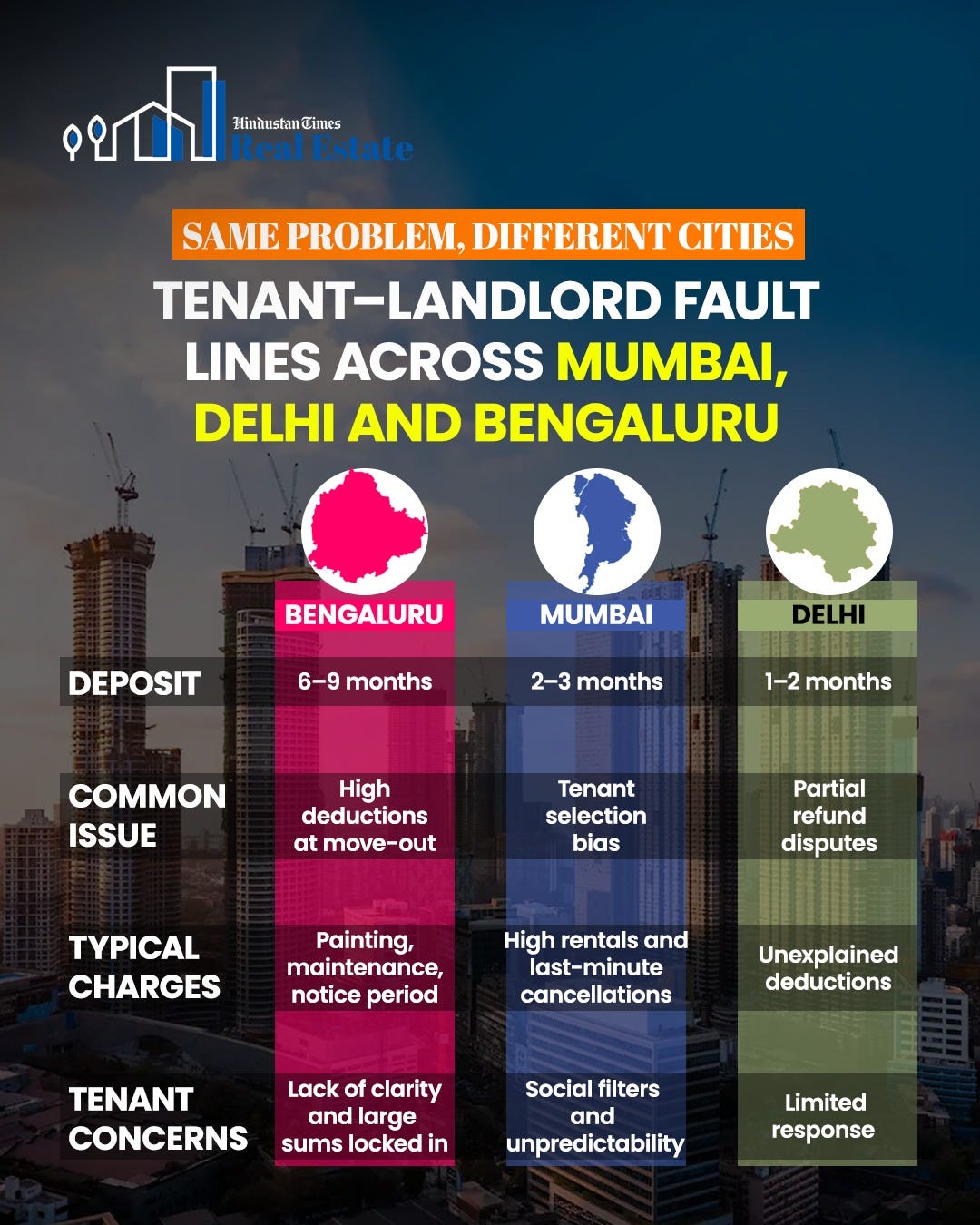
In the Silicon Valley of India, hefty security deposits, typically six to nine months’ rent, are the norm. For a ₹50,000 monthly apartment, that translates to a locked-in upfront range of ₹3 lakh to ₹4.5 lakh. Compare that with Mumbai, where deposits are usually capped at two to three months, or Delhi NCR, where one to two months is more common, and the contrast is stark. The friction often surfaces at the time of moving out. Tenants in Bengaluru frequently report deductions that go beyond standard notice clauses—most notably, a full month’s rent for painting and maintenance. While landlords argue these charges cover deep-cleaning of bathrooms, minor repairs and security-related changes like lock replacements, tenants say the real issue is opacity. These costs are rarely explained upfront, often assumed, and almost always non-negotiable, existing in a grey zone between contract and convention. In cities like Noida and Gurugram, practices may vary. Still, Bengaluru stands out for how entrenched such norms have become, turning what should be a straightforward transaction into a far more layered experience.
Over the past week, a series of tenant accounts has brought this tension into sharp focus. In one case, a tenant in Bengaluru claimed that his landlord deducted two months’ rent from the security deposit—one toward the notice period, according to the agreement, and the other toward painting and maintenance. Tenants in the tech capital described such deductions, often a month’s rent for painting, not as an exception, but as the norm. Painting deductions, often pegged to one month’s rent, have become almost institutionalised in Bengaluru. Landlords argue the logic is straightforward: rising labour costs, higher material prices, and the need to prepare the home for the next tenant. In many cases, the charge extends beyond a fresh coat of paint, covering deep cleaning, minor plumbing fixes, latch replacements and even lock changes. This ambiguity extends beyond move-out scenarios. In another instance, a tenant alleged that despite paying a premium for a covered parking space in Bellandur, the landlord reassigned it mid-tenancy while continuing to charge for it. The consequence is structural: when the upfront stake is this large, every deduction, whether for painting, repairs, or notice, feels consequential. For tenants, it becomes a question of fairness; for landlords, one of risk coverage. And risk, from the landlord’s perspective, is not hypothetical. Property damage, unpaid dues, and the uncertainty of tenant behaviour are frequently cited as reasons for conservative financial safeguards. But as these safeguards grow, so does tenant pushback. The same underlying disagreementsThese disputes are not occurring in isolation. Across cities, rental markets are revealing similar fault lines, albeit in different forms. In Mumbai, for instance, a recent case highlighted how non-financial factors can disrupt transactions altogether. A couple alleged that a finalised rental agreement was cancelled at the last minute after the landlord chose to rent to a married pair instead. Everything looks fine until they hear “unmarried couple”, the tenant said, pointing to persistent social filters in housing decisions. In Delhi, one tenant alleged that after living in a 1 BHK for 11 months and paying two-months security deposit of ₹55,600, the landlord deducted ₹16,000, citing “false claims”, despite the home being well maintained. The tenant said that he even sent a formal letter seeking justification for the deductions, but received no response. Back in Bengaluru, however, the dispute is more financial, procedural, and arguably more systemic. The combination of high deposits, informal practices, and uneven enforcement of agreements creates an environment where both sides operate with caution. Thanks for reading! Subscribe for free to receive new posts and support my work.
|







0 टिप्पणियाँ: