

What happened to T20WC’s hottest stars?A plethora of 2026 T20 World Cup stars have faltered in the ongoing Indian Premier League season.
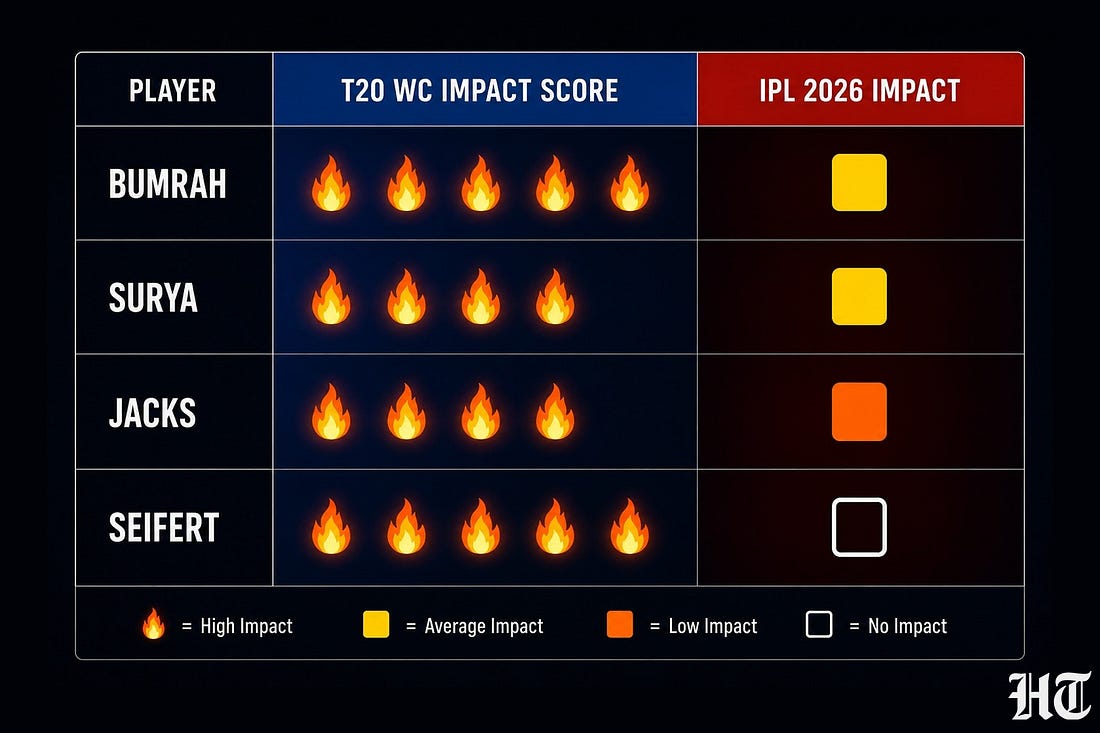
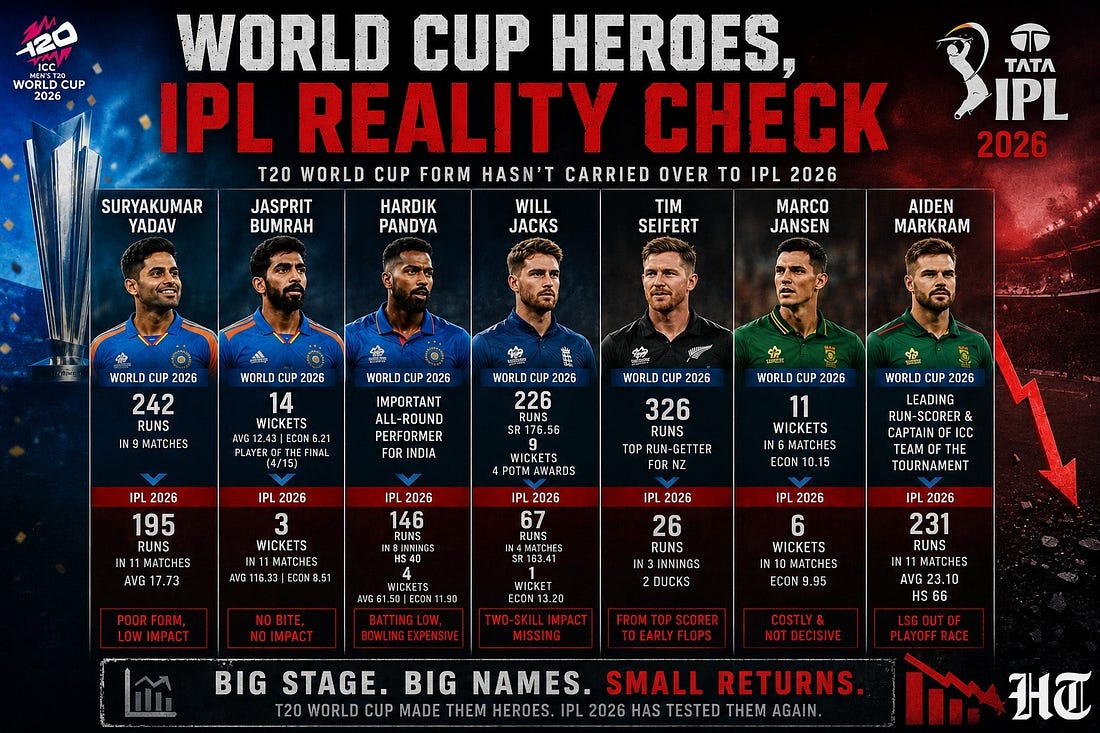
The T20 World Cup in February-March gave several players a fresh layer of authority. IPL 2026 has stripped much of it away. Barely weeks after the global tournament, some of its most visible performers have run into a far harsher league season. Suryakumar Yadav came in as India’s World Cup-winning captain. Jasprit Bumrah arrived after a 14-wicket tournament and a Player-of-the-Final spell of 4/15. Hardik Pandya carried his all-rounder value from India’s campaign. Will Jacks had 226 runs, nine wickets and four Player-of-the-Match awards. Tim Seifert had 326 runs and finished among the top scorers. Marco Jansen had 11 wickets in six games. Aiden Markram had the runs and the leadership credit from South Africa’s campaign. However, the IPL has not rewarded that reputation. The Mumbai Indians are already out after earning only six points from 11 matches. Lucknow Super Giants have also slipped out of the playoff race. Several players who looked decisive at the World Cup have spent the IPL either chasing form, carrying weak numbers, or failing to turn matches in their franchises’ favour. Mumbai’s World Cup core has collapsed togetherThe strongest thread runs through the Mumbai Indians. Their season has been hurt by several high-profile players failing simultaneously. Suryakumar’s case is central because of the contrast between status and output. He came into the league as the captain who had led India to the T20 World Cup title. He had also made 242 runs in nine matches during the tournament, giving India both presence and tempo through the batting order. IPL 2026 has been much thinner. His first-ball duck against Royal Challengers Bengaluru pushed his tally to 195 runs in 11 matches at an average of 17.73, his poorest IPL average since 2017. For a batter of his range, that is a major drop. Suryakumar is picked to change the pace of an innings. Mumbai needed him to control the middle overs, attack spin, and pull chases back from awkward positions. Instead, his season has remained stuck in starts, soft exits and pressure innings that have not opened up. When a player with his reputation averages below 20 across 11 games, the damage spreads beyond one batting slot.
Jasprit Bumrah’s numbers are even sharper. In the World Cup, he took 14 wickets at an average of 12.43 and an economy of 6.21. He struck once every 12 balls. In the IPL, he has only three wickets in 11 matches, with his average rising to 116.33 and his strike rate stretching to 82 balls per wicket. Mumbai can live with some bowlers leaking runs if Bumrah is taking wickets. They cannot live with Bumrah being reduced to only a containment option. His economy of 8.51 is still better than most MI seamers, but that is not the standard he sets. MI use him to close innings, break partnerships and force opposition batters into caution. This season, the fear factor has been missing. The wickets have dried up, and Mumbai’s bowling has looked ordinary without his usual bite. Hardik Pandya’s season has added another layer to that collapse. He was one of India’s important all-round pieces at the World Cup, the kind of cricketer who gives a side batting depth, important seam overs and high-pressure utility. For MI, the return has been narrow. He has 146 runs in eight innings with a highest score of 40. With the ball, he has four wickets at an average of 61.50 and an economy of 11.90. Those numbers become heavier because Hardik is also the captain of the Mumbai Indians. A specialist batter can have a lean season and still remain one part of a wider problem. But a captain-all-rounder disrupts the team balance - if he does not score enough, the finishing weakens. If his overs are expensive, the bowling structure bends. If the team loses, every decision sits under the same glare. Will Jacks completes the MI angle. His World Cup numbers made him one of the most attractive multi-skill players in the format: 226 runs at a strike rate of 176.56, nine wickets, and four Player-of-the-Match awards. That is not a small sample of promise. It is a tournament-winning value. The IPL has given MI only fragments. Jacks has 67 runs in four matches. His strike rate, 163.41, shows the hitting has not vanished, but the influence has. Four matches have brought no fifty and not a single inning of value to MI. His bowling has been worse: one wicket at an economy of 13.20. A player sold by the idea of two-way impact has not delivered enough in either column.
Overseas stars have also lost their World Cup edgeTim Seifert is another strong example. His T20 World Cup was built on volume and aggression. He made 326 runs and stood near the top of the run charts. That kind of tournament should have given KKR a ready-made top-order weapon. The IPL has gone the other way. Seifert’s start for KKR has produced only 26 runs in three innings, including two ducks. The collapse is severe because his World Cup value came from repeated scoring, not one isolated innings. A batter who looked settled in a global tournament has looked rushed and disposable in the IPL. Marco Jansen’s drop is quieter but still fits the pattern. He had 11 wickets in six World Cup matches and remained a wicket-taking option for South Africa despite going at more than 10 an over. Punjab Kings have not received the same incision. Jansen has six wickets in 10 matches, with his economy rate again close to 10. His batting has not provided enough lower-order value to balance that return either. The left-arm angle, height and bounce remain useful on paper, but the actual match impact has been short. Markram sits at the softer end of this group. His World Cup gave him runs and captaincy credit with South Africa. His IPL numbers for LSG, 231 runs in 11 matches, are not disastrous. They are simply underwhelming for a player carrying recent leadership weight. LSG’s exit makes that drop feel larger because Markram’s campaign has lacked the authority his World Cup suggested. The pattern is not about one player losing form. It is about how quickly T20 reputations can be tested again. The World Cup offered compressed drama, clear roles and a short burst of high-value performances. The IPL has demanded repeat proof across weeks of travel, changing surfaces, heavier scrutiny and franchise pressure. Suryakumar has not matched the authority of a World Cup-winning captain. Bumrah has not matched the control of a tournament-leading bowler. Hardik has not supplied enough all-round value. Jacks has lost his two-skill punch. Seifert has gone from top-order force to early-season failure. Jansen and Markram have slipped from influence to the margins. So while the World Cup revolved around these superstars, IPL 2026 has turned them into cautionary numbers.
|







0 टिप्पणियाँ: