

Why does an art event taking place in Italy matter?Three arguments to make a case for thinking of the Venice Biennale as more than a jamboree for rich art collectors (which, no doubt, it also is)
One. An open invitation to shift the way we see things.
The curator of the event, Koyo Kouoh, passed away last May. By then, however, the 57-year-old Swiss-Cameroonian curator had set up her team for the Venice Biennale, and written the curatorial note. Her team later built upon the framework created by her. This year’s theme, In Minor Keys, is remarkable in its breadth and depth of forethought. Her reference to the tone of the minor musical scale was an exhortation to reorganise the way we view the world. To shift out of “the anxious cacophony of the present chaos raging through the world” and pay attention, instead, to those “producing beauty in spite of tragedy, the tunes of the fugitives recovering from the ruins, the harmonies of those repairing wounds and worlds.” It was prescient on Kouoh’s part to do so, because barely months after her death, Israel and America attacked Iran and sparked an ongoing West Asian geo-political crisis whose ripples continue to be felt across the globe. The way we think about a global crisis is seldom rational: narratives collide and snowball into something bigger inside our heads. For instance, many simplistically map the Islamic republic regime’s culpability in its treatment of dissenters to the actions of religious fundamentalist terror networks. Kuouh’s vision reminds us of “the other worlds that artists make, the intimate and convivial universes that refresh and sustain even in terrible times; indeed, especially in terrible times.” Two. An opportunity to see what compromise looks like in progressive spaces. The 61st edition of the Venice Biennale, which began on May 9, itself has been grappling with a series of high-octane eruptions, followed by organisational clean ups. Russia, which wasn’t given a national pavilion in the past two editions, managed to make an appearance at the festival’s preview held last week with techno music blaring out of its pavilion. Despite calls for it to be barred from the Biennale this time, too, the organisers decided to invite the country to participate — however, its pavilion will remain shut for the duration of the festival. In what seems like a strange compromise, the work inside — flower sculptures — will be visible through the windows, the Guardian reported. Shortly before the vernissage, the five-member jury (selected by Kuouh) led by Solange Farkas, which selects the winner of the Golden Lion prizes, resigned en mass after stating that they would not consider entries from countries whose leaders were subject to international arrest warrants —a reference to Israel and Russia, no doubt — which meant that the Golden and Silver Lions, both highly prestigious awards, would not be handed out on May 9. The organisers said that the awards would now be handed out on November 22, and also announced that two new awards would be given, based on visitors’ choices, to any one of the “national participations included in the 61st Exhibition, as per the official list, following the principle of inclusion and equal treatment”. Three. The India pavilion as a site of complex ideas and technical excellence. Other Indian artists like Nalini Malani, Himali Singh Soin (with David Soin Tappeser), Shilpa Gupta and Gauri Gill have also been invited by other institutions to showcase their works. Five artists are part of the India pavilion.
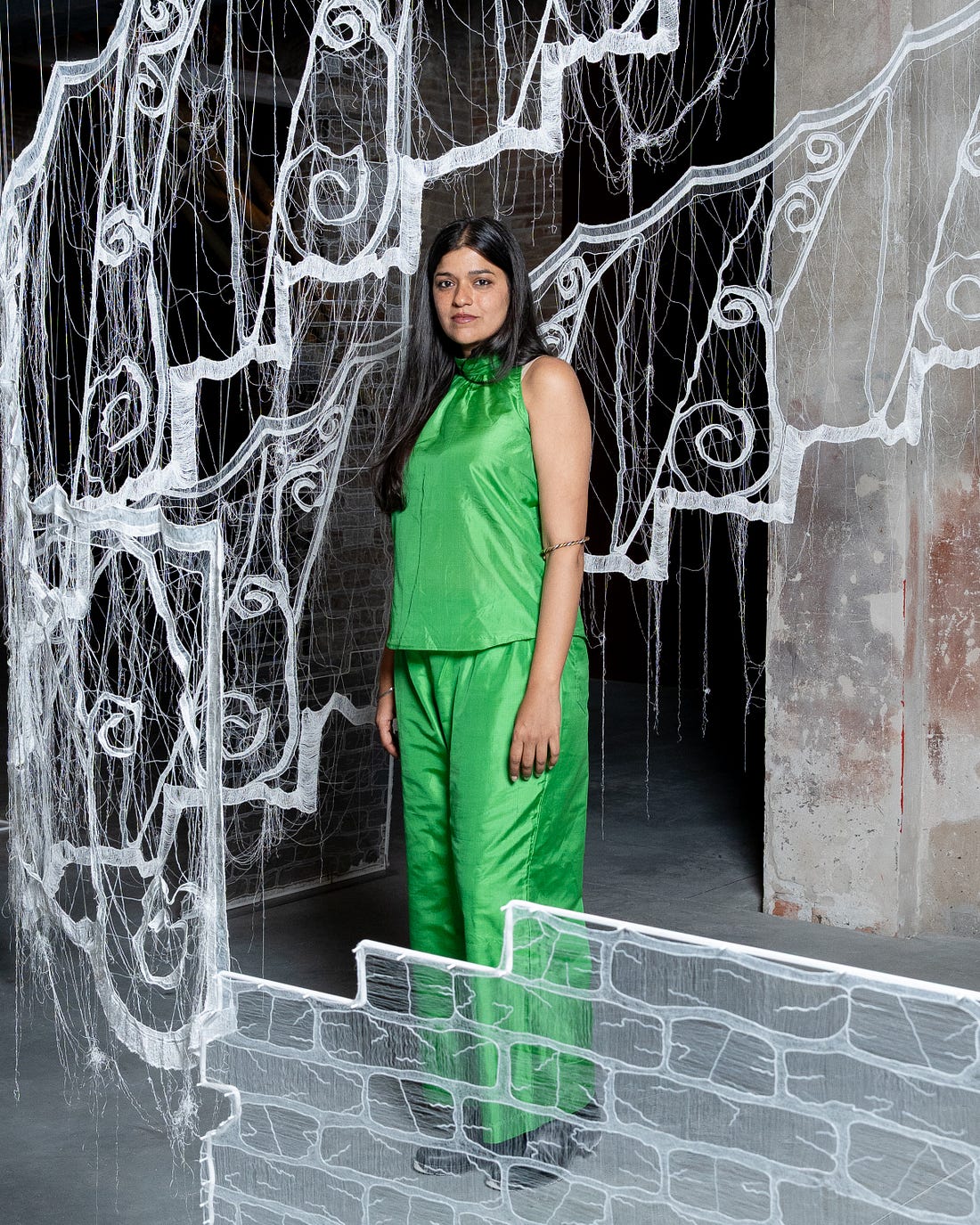
The Delhi-based artist, who works across mediums from paint to threadwork, revisits her grandparents’ home, which once stood on 33 Link Road in New Delhi, in her latest installation at the India pavilion. Before the house came down, Singh returned and measured it, noting down every crack on the wall and broken fragment of brick. She recorded the texture of peeling walls, the size of the hinges and bolts. Then she got to work. She recreated these walls and doors in life-size dimensions, albeit in embroidered panels held suspended over thin steel frames measured with precision down to the “quarter of a millimeter”. Singh, who worked with a team of four embroiderers to make these panels over soluble fabric, wanted the installation to be immersive, “where people would walk through architectural fragments of a broken home”, “a home that you can't inhabit any longer, whose walls don't support you, and which you can’t enter. It's fugitive, and subtle. It’s a home that only lives within me, held by memory,” Singh said.
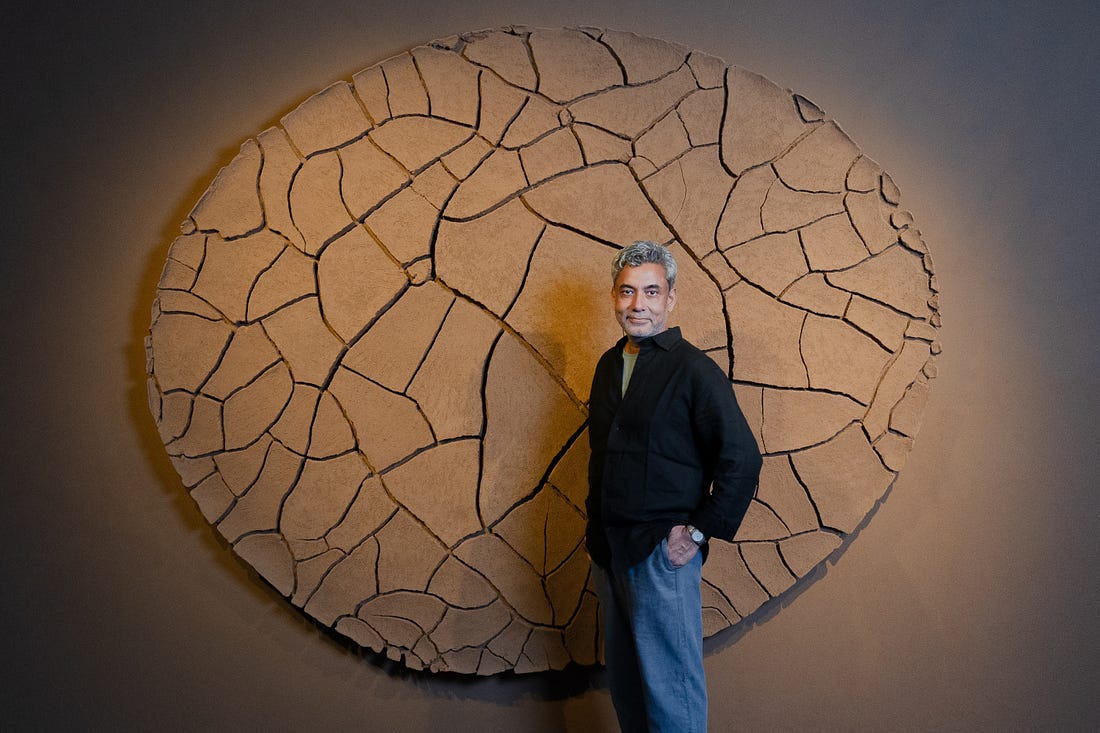
Bala’s 10 ft by 18 ft work made up of dried earth, clay and resin on display at the national pavilion came through an act of surrender. The artist’s initial plan was to make a piece along the lines of Drift, a 2022 installation that showed lines of cracked earth. However, his new work titled Not Just for Us, was larger which necessitated working outside his studio. He made the mold, into which he poured tonnes of earth mixed in water, and left it to dry. First the earthworms appeared. Then the shoots of tiny plants sprouted. This brought the chickens, and peacocks; a snake slithered by, a monkey dropped in --- as the piece dried over the course of 75 days, creatures left their imprints over it. Even Bala’s year-old child inadvertently walked over the drying sculpture. At first Bala was concerned --he had wanted to create an installation that would recall the traces that evaporated water leaves behind on drying earth. Then he realised how the piece came to have a life of its own. “It just made me think about how humans are so possessive about everything. Even soil.”
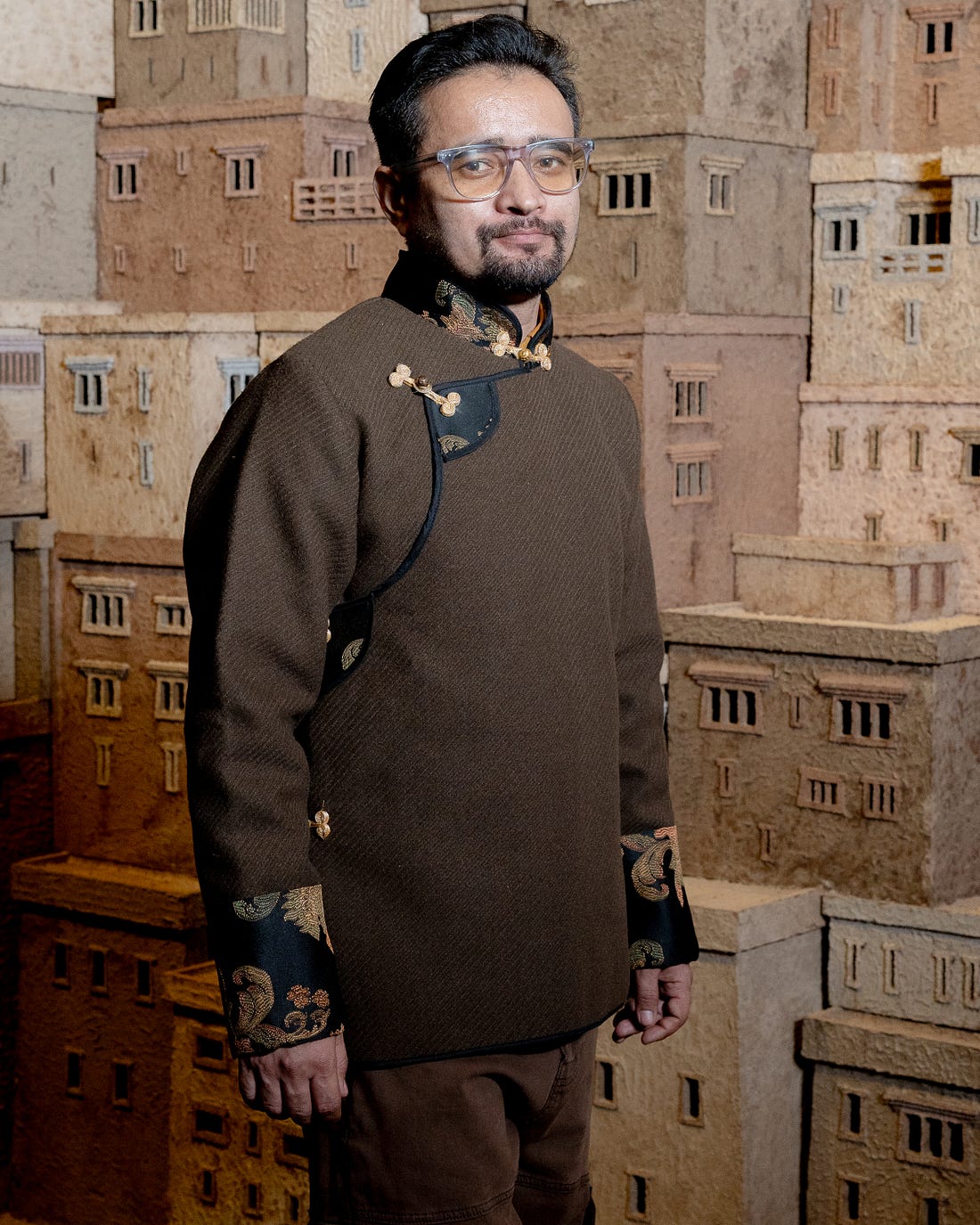
Tashi, who was the first artist from Ladakh to win the national award from Lalit Kala Akademi in 2025, has depicted houses from his region in his installation — a large work that is a foot long and 16 feet wide and is made up of 80 individual pieces. The installation is a set of traditional homes in Ladakh, roofs, windows and all. “I have used materials like clay and cardboard apart from papier-mâché because I wanted the installation to also show the textures and colours of Ladakh, too,” he said. This nostalgia drives Tashi’s practise. “My work is connected to the landscape and the architecture of the place I hail from. In Ladakh, we use a lot of locally-sourced material like stone, sand, and wood. People understand the environment they live in, and use it to make their homes. There is an interconnectedness. I myself use paper from school textbooks, reuse them to make papier-mâché,” he said.
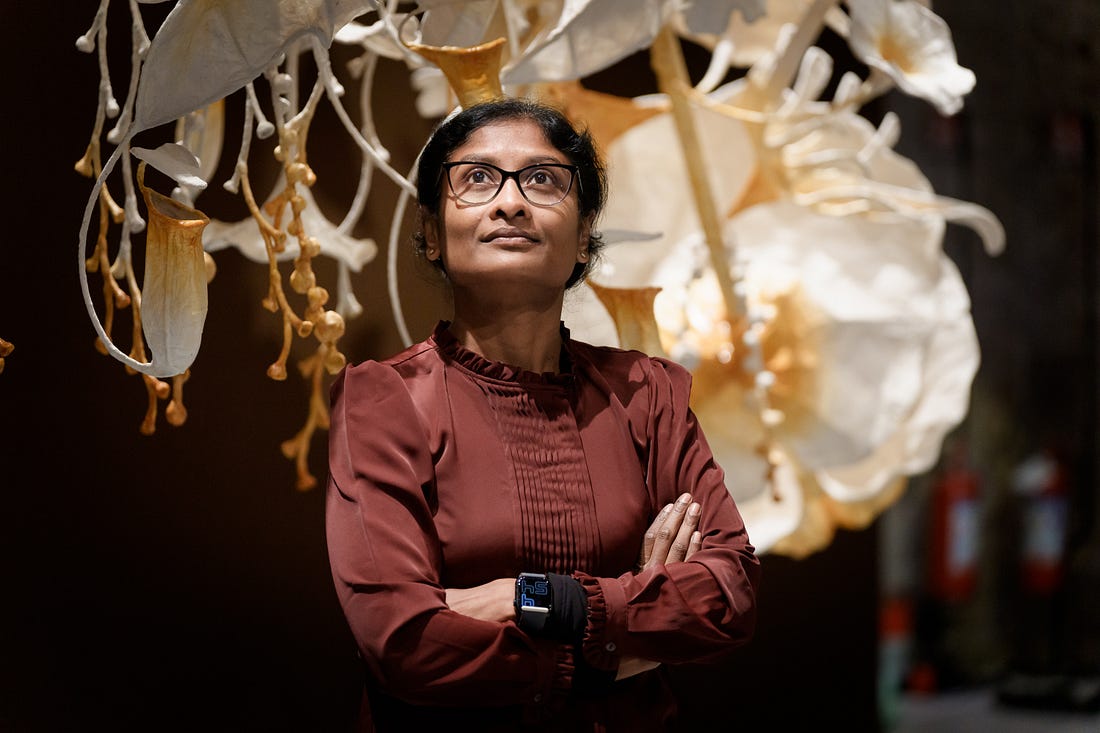
Ranjani Shettar’s sculptural installation Under the Same Sky, is made up of 74 parts, which when assembled together, became 52 independent pieces that needed to be suspended. It is also large in terms of scale: two feet off the ground, up to 20 feet high, and 27 feet wide. Made by hand using a special mix of woven cotton fabric and lacquer over a steel frame, Shettar has developed this material through careful experimentation over years. As a result, the works appear weightless, forming a conceptual garden that visitors move through. Her practice reflects the rhythms of making and tending, positioning nature and craft as integral to the emotional landscape of home. “I am inspired by nature, and as an artist, I wish to enjoy its beauty, and present it to my audience. The way I use space in my sculptures too is deliberate. It’s almost like an active ingredient of my work. I also like to make people move maybe unconsciously and respond to the movement that’s already in the sculpture. In a formal sense, it is important for me that people see the work from all around and that there is no such thing as the back of a sculpture,” Shettar said.
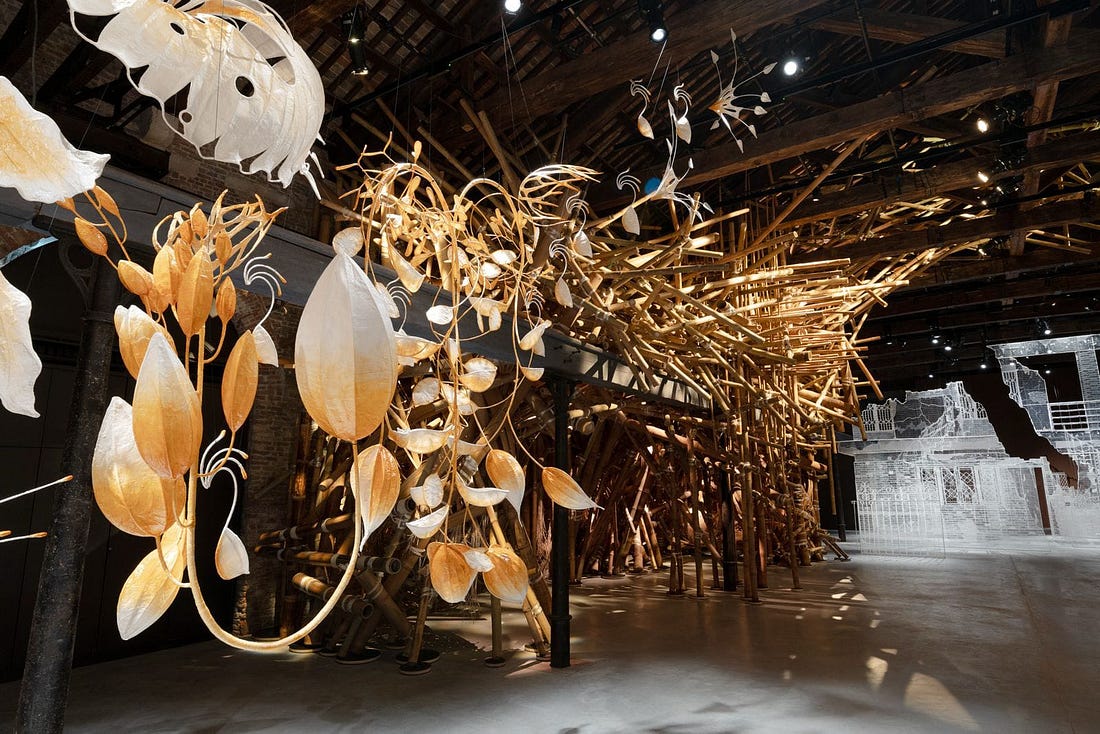
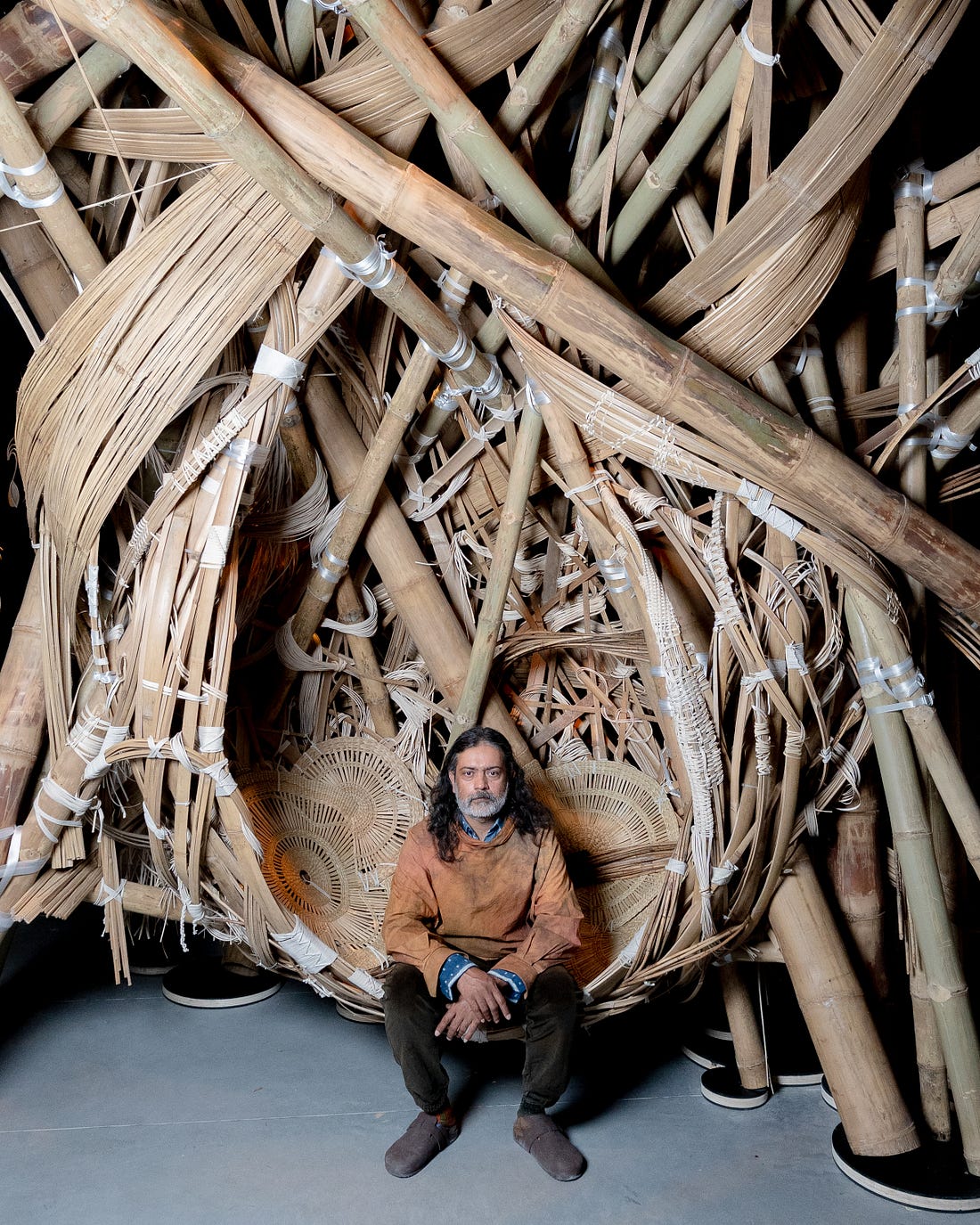
The work titled Chaal, is a site-specific installation, which means that Waqif and his team had to create it specifically at the pavilion’s site in Venice. His team comprising eight artisans from West Bengal, and an architect from Manipur, and even a civil engineer who has an ease of working with bamboo, got to work. Although the work entailed a good amount of improvisation, the process was fairly familiar, Waqif said. “I left a lot to the team. In fact, I went away for a while so that they would figure the piece out, and when I returned, I was heartless in editing stuff out from what they’d made,” Waqif said. This type of decentralized working style has to come to define his practice, Waqif said. It applies not just to structural choices but also aesthetic ones, he said. The sculpture in bamboo, with weaving and lashing, evokes the scaffolding omnipresent in Indian cities and offers a dramatic counterpoint to the other installations, signaling renewal and change. Dhamini Ratnam is culture editor at Hindustan Times. Ways of Seeing is her weekly newsletter that takes you through only the most important cultural happenings you need to know of. You can write to her at dhamini.ratnam@htlive.com or comment on this newsletter below. Edited by Dhrubo Jyoti.Thanks for reading Ways of Seeing! Subscribe for free to receive new posts and support my work.
|






0 टिप्पणियाँ: