

IPL 2026: No country for old men?IPL feels quicker, less patient and decidedly younger. Is the old guard on its way out?
Hello! Welcome to the first edition of ‘The Data Trap’ by CRICKIT BY HT, where cricket data meets context, clarity and the truth behind the game. The idea is to look beyond the scoreboard to uncover the patterns, value and hidden shifts that matter. Thanks for reading! Subscribe for free to receive new posts from CRICKIT BY HT. IPL 2026 has made one thing impossible to ignore. The tournament feels quicker, less patient, and more than willing to hand over to younger batters than the league’s old rhythms would normally allow. New names are not just appearing. They are arriving with a licence. They are scoring before the game settles, and often before reputation can slow them down. But that is exactly where this season becomes more interesting than the easy headlines. Because when the numbers from IPL 2023 to IPL 2026 are placed side by side, they do not say the league has suddenly become a playground for kids. They say something sharper. The IPL is getting faster every year, and a growing share of that speed is moving toward younger and younger-prime batters, even while the bulk of total runs still remains with the established stars.
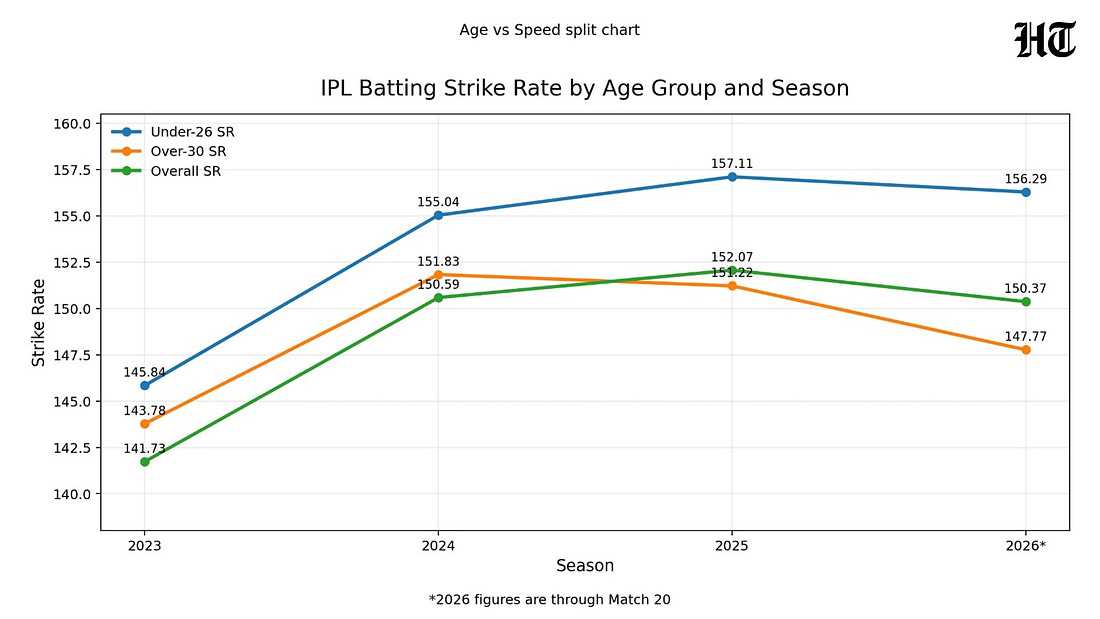
The first change is in the speed of the league itselfThe broadest trend is clear enough to start there. In the serious batting sample built from players with at least 100 balls across IPL 2023 to 2025, the overall batting strike rate stood at 141.73 in 2023. It jumped to 150.59 in 2024 and then rose again to 152.07 in 2025. Through Match 20 of IPL 2026, the batting strike rate sits at 150.37, while the overall scoring strike rate is 158.29, and the season run rate stands at 9.50.
Why the age question mattersThis is why the age debate is worth having in the first place. IPL 2026 has not merely produced more runs. It has produced the feeling that younger batters are no longer waiting quietly for their turn. Vaibhav Sooryavanshi, Ayush Mhatre, Sameer Rizvi and Mukul Choudhary have given the season fresh energy. Yashasvi Jaiswal, Dhruv Jurel and Abhishek Sharma belong to a slightly older but equally important part of the same movement. The common thread is not just age. It is intent. Still, seasons can trick the eye. A few breakouts can create an illusion of total takeover. That is why the only useful way to judge this is over multiple years. Once the 2023-25 historical base is brought in, with 2026 added as the live layer, the picture becomes far more credible. The question is no longer whether some young players are doing well. The question is whether a larger share of the league’s tempo is actually shifting younger. The numbers say yes. The youngsters are playing faster for longerAcross IPL 2023 to 2025, the Under-26 group increased its share of total runs from 30.2% in 2023 to 33.4% in 2024 and then 35.9% in 2025. Its share of balls faced moved almost in lockstep, rising from 30.1% to 32.9%, then to 35.3%. That shows the younger side is not only scoring quickly in cameos, but also that It’s being trusted with more of the innings.
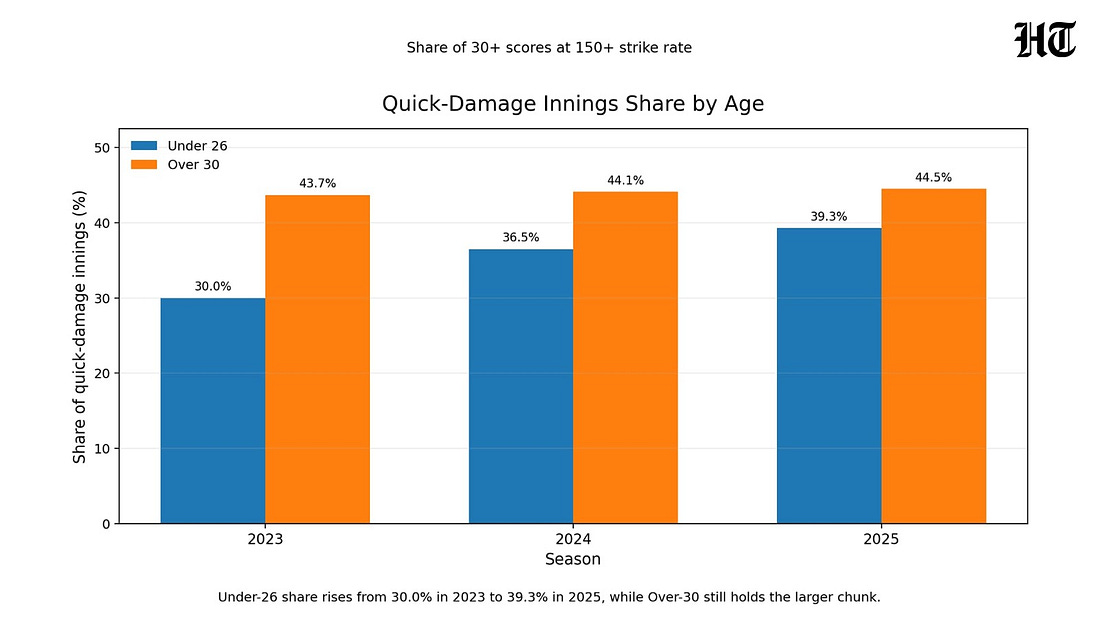
And when that group does bat, it is doing so at increasing speed. The Under-26 strike rate climbed from 145.84 in 2023 to 155.04 in 2024, then to 157.11 in 2025. This is one of the strongest signs in the entire analysis. The younger side is taking more of the batting opportunities and converting them into quicker runs. The sharpest version of that trend appears in the “quick-damage” category. Under-26 batters accounted for 30.0% of all 30-plus scores made at 150-plus strike rate in 2023. That rose to 36.5% in 2024 and then to 39.3% in 2025. A larger slice of IPL’s fast, match-shaping knocks is now coming from the younger side of the batting pool. That is not a slogan. That is the backbone of the argument.
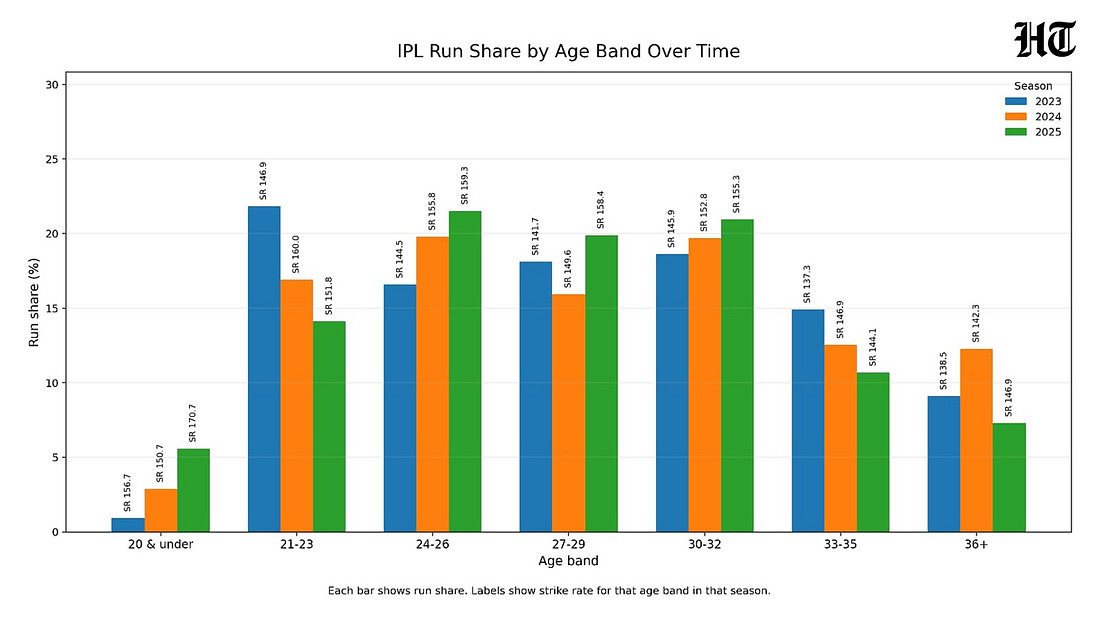
The old stars still own a huge part of the scoreboardThis is where the piece becomes more honest than the usual generational chest-thumping. Even as the younger side gains more of the league’s fast batting, the Over-30 group still controls the biggest chunk of total output. Across IPL 2023 to 2025, Over-30 batters accounted for 45.6% of runs in 2023, 47.1% in 2024 and 48.0% in 2025. Their share of balls faced also rose from 46.0% to 47.4% and then to 49.0%. That means the old guard has not been shoved out of the game’s centre. Virat Kohli, Rohit Sharma, Jos Buttler, Heinrich Klaasen, Sanju Samson, Shreyas Iyer and others still sit deep inside the batting economy. Even their strike rates stayed healthy at 143.78, 151.83 and 151.22 across those three seasons. This is why the story cannot be framed as “youngsters have taken over the IPL”. That would be lazy and unsupported. The better reading is that the scoreboard still has older ownership, but the league’s speed map is ageing downward. The younger-prime, not just teenagersOnce the player pool is split more finely, the trend becomes even more interesting. The strongest shift is not toward children storming the league on their own. It is toward the younger-prime zone. When the serious batting pool is broken into 20 and under, 21-23, 24-26, 27-29, 30-32, 33-35 and 36-plus, the key movement happens around 24-26. In 2025, the 24-26 age band became the single biggest run-share group in the serious sample. That is a major clue. It tells us the IPL is not becoming teenage cricket so much as becoming earlier-prime cricket. The next generation is not only arriving. It is maturing faster into the centre of the batting economy. That is a much stronger line than a simple youth-wave cliché. It explains why the season feels younger without requiring the data to pretend veterans are irrelevant. The real change is that the younger-prime band is beginning to carry more of the tournament’s batting force. IPL 2026 has made the pattern easier to seeThe live season supports that historical trend rather than disrupting it. In the age-covered 2026 sample through Match 20, Under-26 batters account for 37.9% of runs and 36.4% of balls, at a strike rate of 156.29 and an average of 37.51. Over-30 batters still account for 42.5% of runs and 43.1% of balls, but at a lower strike rate of 147.77 and an average of 32.65. That split says almost everything the season is trying to say. The older group still holds the bigger slice of total volume. But the younger side is scoring faster and, in this season, posting stronger averages as well. It is not full ownership yet. It is rising influence over how the game is played. The finer age split sharpens it further. In the covered 2026 sample, the 24-26 group accounts for 33.4% of runs, 31.9% of balls and a strike rate of 157.13. That is not a fringe cluster. It is the live engine room of the season. It is the clearest proof yet that the centre of gravity in IPL batting is moving toward the younger-prime bracket. This is also a team-structure storyThe age shift is only part of the picture. IPL 2026 has also shown that raw aggression alone is not enough. The teams making the strongest batting impressions are not merely the noisiest. They are the ones combining pace with shape. Royal Challengers Bengaluru have scored 894 runs in four matches at a run rate of 11.18. Rajasthan Royals have looked like one of the cleanest embodiments of the season’s new batting order, combining pace with lower wicket damage and efficient tactical use. Gujarat Titans, in a different way, have shown how managed tempo through phases can still be decisive. The lesson from the season is not that one great powerplay or one freak finisher is enough. Teams now need innings that stay alive without surrendering tempo in the middle. That is what makes this shift more serious than a few flashy highlights. The IPL is not only getting faster. It is getting structurally harsher. There is less room for drift inside an innings, and more value in batting units that can attack without losing shape. What has changed, and what has notThe easiest version of this story would be to say the kids are here and the old stars are done. The data does not say that. What it says is better. Older greatness still matters. Established stars still own a huge share of total runs. But a bigger share of the league’s fast batting, its quick-damage innings and its live tempo now sits with younger and younger-prime batters. More innings are being shaped by that side of the age curve, even before the full scoreboard has shifted with it. That is why IPL 2026 feels different. Not because experience has vanished, but because speed has started to migrate. The future has not fully replaced the present. But it has moved out of the waiting room. The scoreboard still belongs, in large part, to the old stars. The pace increasingly does not. Thanks for reading! Subscribe for free to receive new posts from CRICKIT BY HT.
|








0 टिप्पणियाँ: