

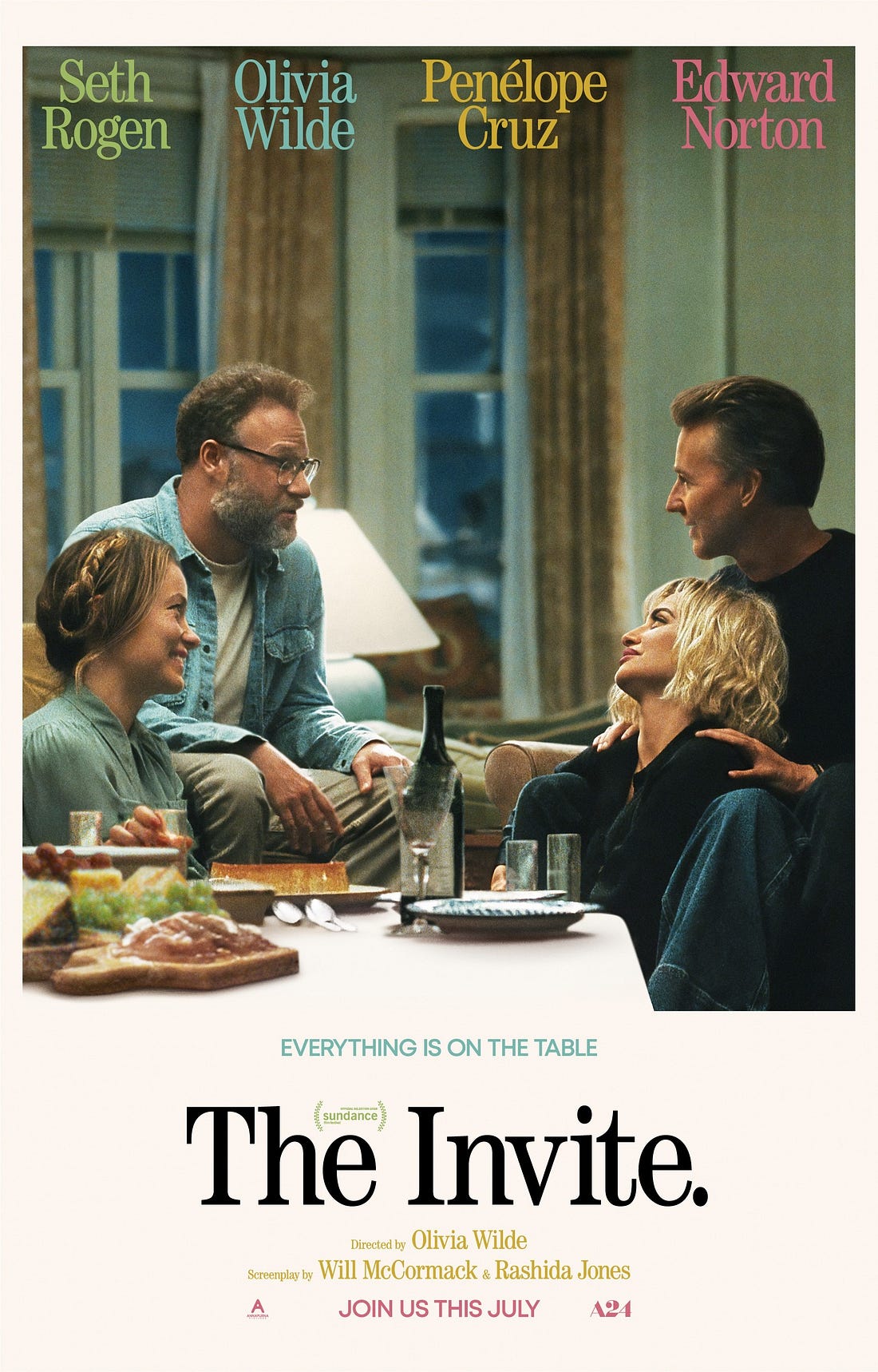
No, I’m not a fan of The Invite. Here’s why.Olivia Wilde's The Invite is steeped in Instagram therapy-speak. Plus, 3 artworks exploring the meaning of home.
I recently watched The Invite on the big screen and left the theatre feeling, yet again, the full force of Instagram’s influence on our lives. What does the Seth Rogan, Penelope Cruz, Edward Norton and Olivia Wilde-starrer have to do with Instagram? Let me dial back a bit. Instagram and other Meta social media platforms rely heavily on a 30-second rule. Once the viewer clocks their “engagement”, the advertiser’s revenue is guaranteed and the algorithm’s effectiveness is noted. We would like to think that Instagram has negatively affected our attention spans, but that’s not necessarily true: those of us who sat in the theatre to watch the whole 107-minute film directed by Wilde, did so without touching our phone screens even once. Attention span, I’m beginning to suspect, is not necessarily a function of format. The impact of Instagram is far more problematic. It has supplied us with content that is terrifyingly boring (hence our sagging attention spans, I’d wager) and what’s worse, we must now consume it in 30-second capsules that offer no context whatsoever, but leave us in media res attempting to make sense of it all. Which brings me back to The Invite. Like Instagram, the film offers a rather glib reading of human sexuality, non-monogamy, and cisgendered heteronormativity that anyone who follows Esther Perel, the famous New York-based psychotherapist on (where else) Instagram, would be all too familiar with. (As you can see, I follow Esther Perel, host of popular couples therapy podcast, Where Should We Begin? and author of two seminal books on the subject, Mating in Captivity: Unlocking Erotic Intelligence and The State of Affairs: Rethinking Infidelity, on Instagram.)
Wilde consulted Perel for The Invite, but all it does is make the film sound like her 30-second reels of relationship advice. To wit: couples who return to the beginning of their relationship can hope to find something to remind themselves of what they fell in love with. Or: Good sex is not about technique or power, but about surrender and openness. Or: Communication without kindness is simply an excuse to perpetuate the cycle of disenchantment and violence. The movie has her DNA all over it, Wilde told NYT in a recent article. “The idea of compersion (finding joy in a partner experiencing pleasure with someone else); the tension between the familiarity of love and mystery of desire; the concept of a relationship being over, but starting a new one with the same person instead of breaking up. All of those are classic Perel,” the article points out. The trouble is that when therapy breaks free from the clinical setting of therapist-and-, in this case, -couple, it turns into byte-sized nuggets of wise-sounding truisms. Instagram is a wasteland of such tasty morsels. And the film, despite its superlative performances, suffers the same fate. To be fair, Wilde’s direction (the film is an adaptation of a 2021 Spanish film, but was considerably reshaped following Perel’s consultation) allows each character to develop into relatable people. Even the subject of consensual non-monogamy (once referred to as ethical non-monogamy) is brought up without any sub-text of shame or judgement. In so far as the couples (Wilde and Rogan, Norton and Cruz) speak about their respective relationships, one could argue that the audience can “hard relate” to some if not most of what is being shared. But resolution — that all-too-pressing need of any film for catharsis — is not the job of therapy, contrary to what many may assume. And though, like Instagram’s reels, the film must keep us hooked, the careful tango of safety and adventure that long-time couples practise requires a lot more than a film script to disentangle Five Indian contemporary art works that say something important about domesticity. Sudhir Patwardhan, Home, 2016:
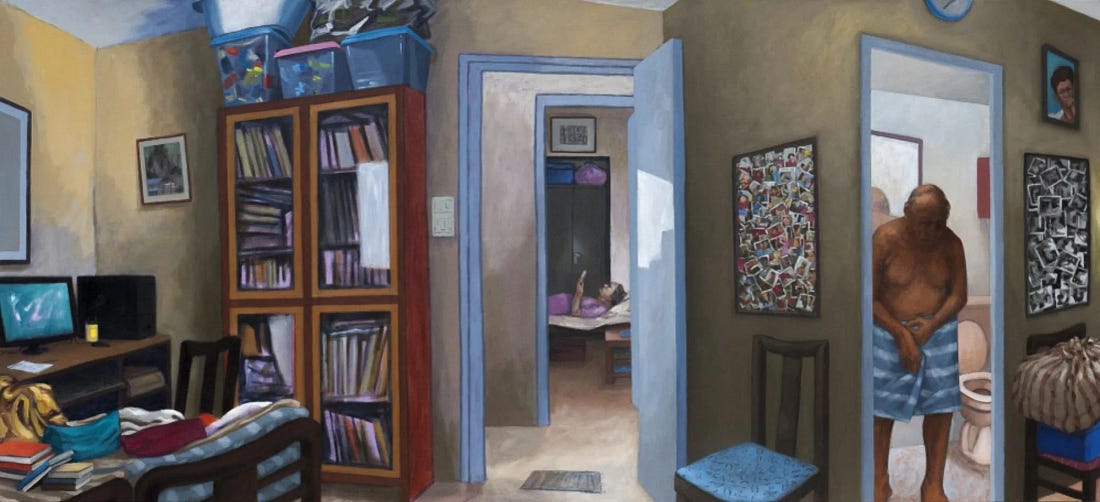
An old man exits from a bathroom, towel wrapped around his waist. In an inner room, a woman lays on her back, reading in bed. Patwardhan, the city artist who shows Mumbai like no one else, in all its grime, dirt, details and humanity, turns the lens into the four walls of a house. We see a crowd here too, but of photographs that fight for space on a board. We see bodies at various states of rest and unrest, but these bodies are intimately related to each other. The distance made visible through the marvelous perspective that Patwardhan has employed on his canvas is the length and breadth of coupledom — separate but together, always in eternal wait of the other. Saviya Lopes, Kaay Banvaycha? (What do we cook today?) 2024:
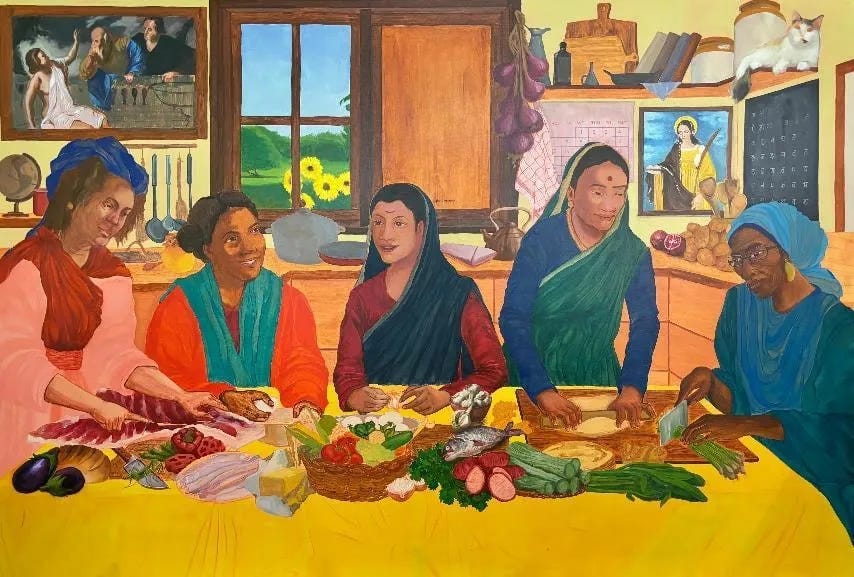
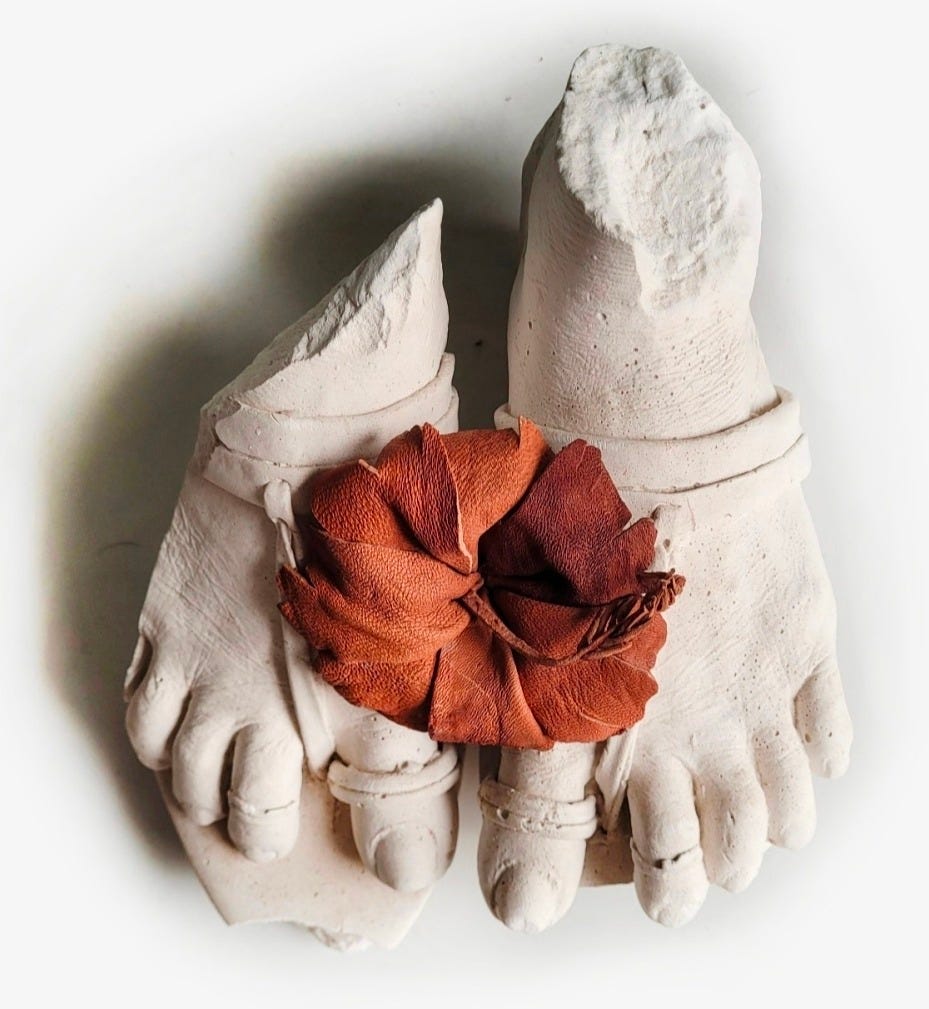
Five women across geographies, timelines, and socio-political positions, sit around a table filled with vegetables and meats. One dices a spring onion, another cuts fillets of meat. The atmosphere is convivial, the setting of a kitchen is bright and crowded with images on the walls — other women, religious figures, renowned for their sacrifice and their work. The women are Artemisia Gentileschi, a 17th century Baroque painter who drew heroic women from myths, bell hooks, an African-American feminist writer who never capitalised her name; Savitribai Phule, an anti-caste crusader who fought for girls’ education; Tarabai Shinde, a strident critic of patriarchy and caste who wrote what is widely considered one of the first modern feminist texts in India; and Sojourner Truth, an American abolitionist and civil rights activist from the 19th century. For Lopes, this private setting is rife with themes of labour, caregiving, sacrifice, and rebellion abound in her choice of subjects, showing us that the personal is always political. Madhukar Mucharla, Not Fixed Yet, 2026: Plaster of Paris and handstitched leather
Mucharla is an artist from Nandi Wanaparthy, near Hyderabad, born into a family of leather workers and farmers. His artistic sensibility was shaped by everyday objects, made by his family members, using leather. Made by them for others — who would continue to practise caste-based discrimination against the makers of these leather works. Mucharla’s use of leather in his artworks is not a coincidence. For him, leather is as domesticated as it gets. His art is a reminder that not every domestic scenario is a middle class nuclear-family or joint-family haven. In his works, Dalit identity interlaces with philosophy on life, material and memory. Dhamini Ratnam is culture editor at Hindustan Times. Ways of Seeing is her fortnightly newsletter that takes you through only the most important cultural happenings you need to know of. You can write to her at dhamini.ratnam@htlive.com or comment on this newsletter below. Thanks for reading Ways of Seeing! Subscribe for free to receive new posts and support my work.
|






0 टिप्पणियाँ: