

A hundred is never enoughRohit Sharma doesn't make quiet comebacks. From 264 to Lord's 138, his ODI career is a story of answering every doubt with something extraordinary.
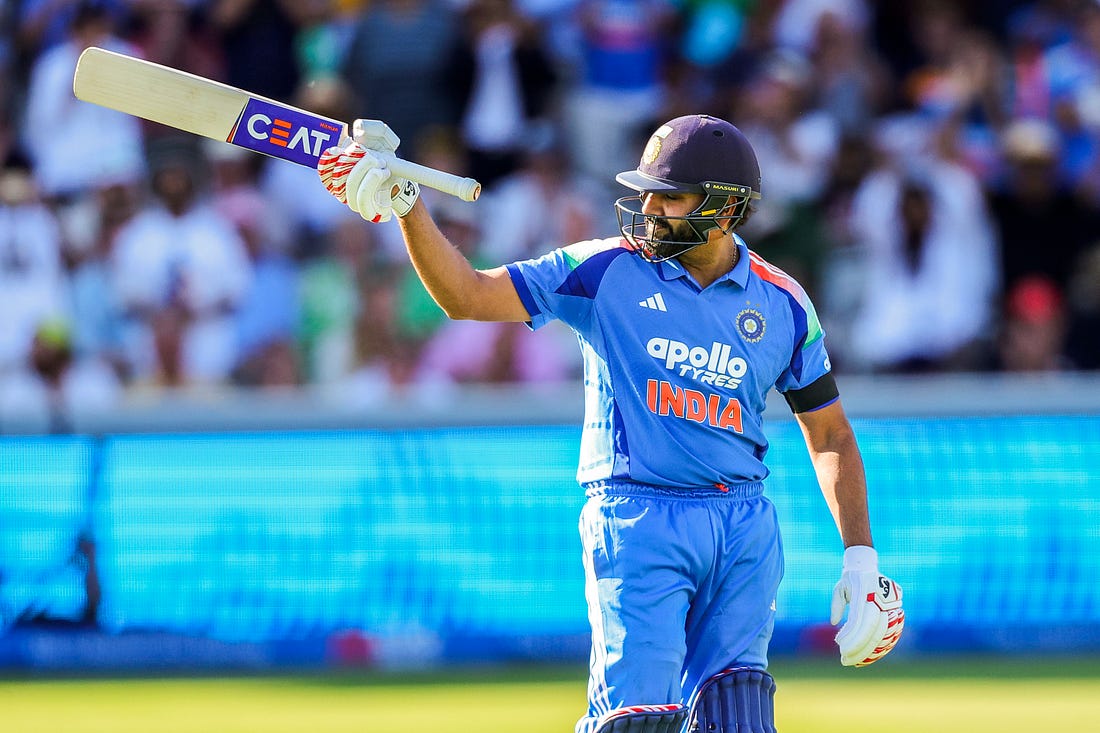
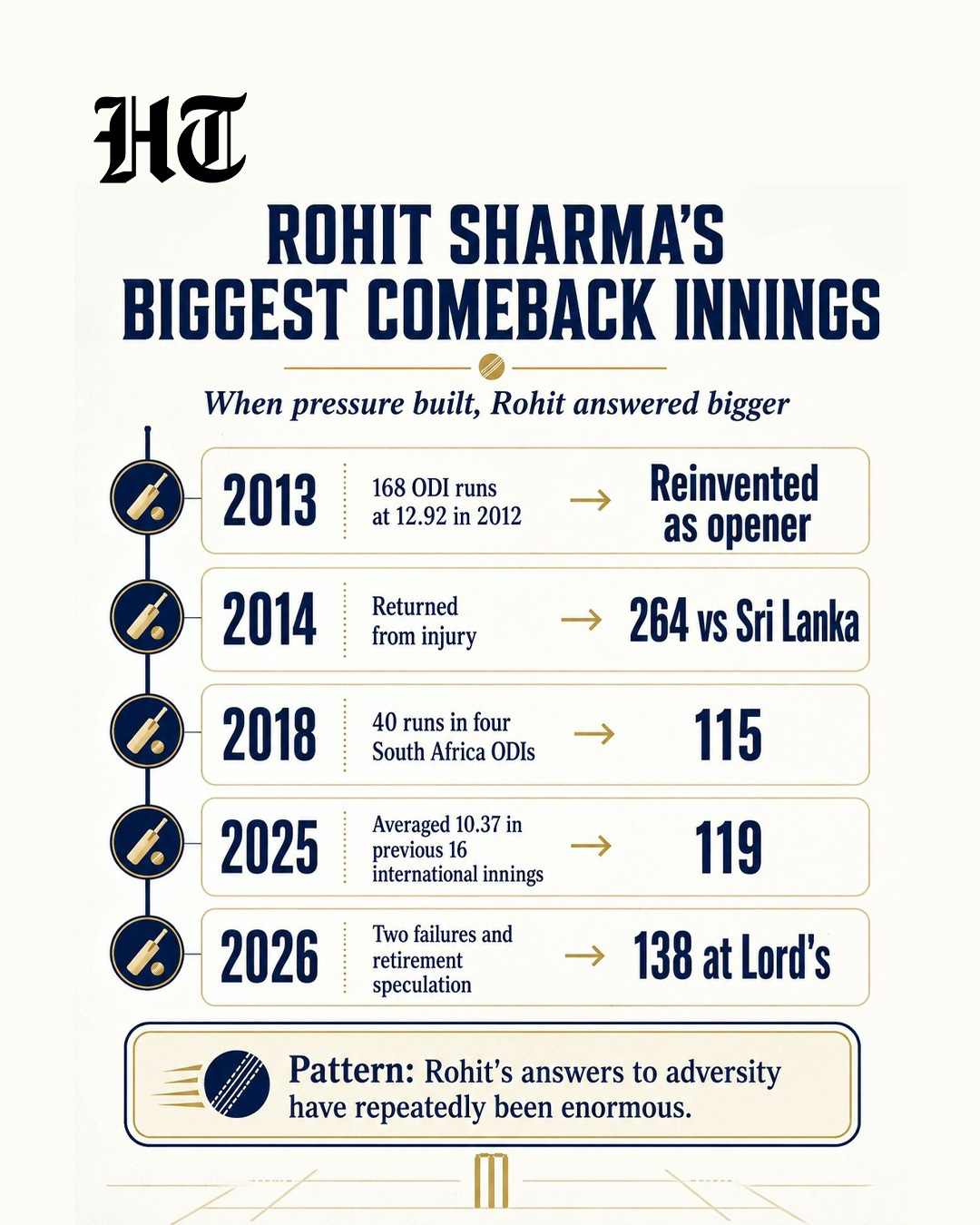
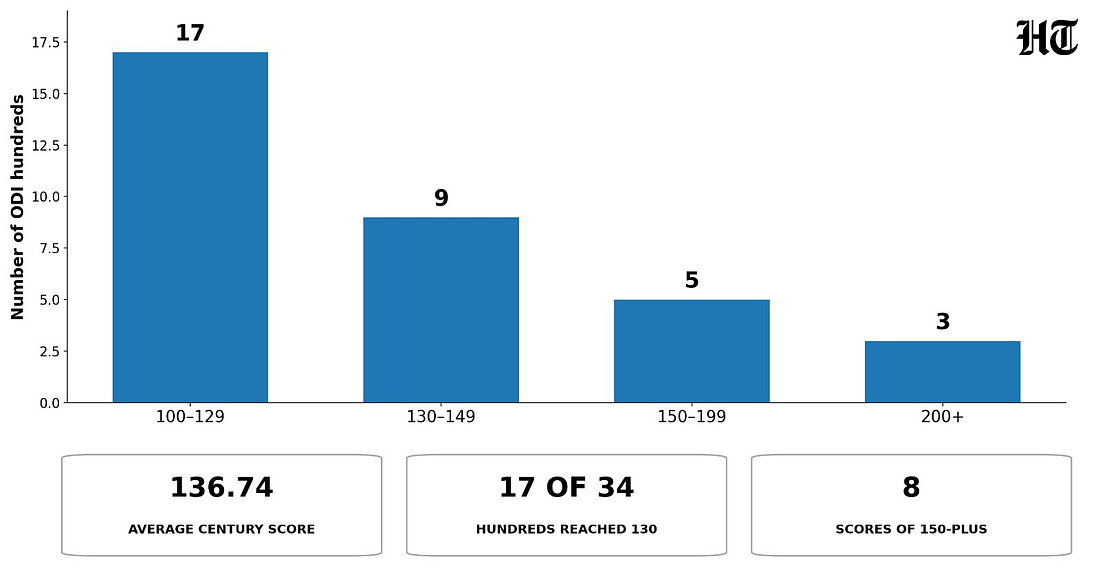
The noise around Rohit Sharma had gathered quickly. Two subdued innings in England, an 11-match wait for an ODI hundred and questions over whether a 39-year-old batter still belonged in India’s plans for the 2027 World Cup had turned the series-decider at Lord’s into an examination of his future. Rohit’s answer was 138 from 110 balls, containing 17 fours and five sixes, in a chase of 388. He added 147 with Shubman Gill and kept India within sight until the 39th over. India eventually fell 27 runs short, but the innings ended the debate in the most Rohit-like manner possible: not by producing just enough, but by producing something enormous. That has been the recurring rhythm of his ODI career. Rohit does not possess a mechanical pattern in which three failures are automatically followed by a century. Many of his hundreds arrived when he was already in excellent touch. The deeper pattern is that whenever uncertainty has threatened to define him, he has repeatedly answered through reinvention - often on a far larger scale than an ordinary return to form. Rohit Sharma’s rebounds have rarely been smallThe first comeback was not a single innings. It was the reconstruction of his ODI career. Rohit scored only 168 runs at 12.92 in 2012, after years without a permanent middle-order role. MS Dhoni’s decision to promote him to open in 2013 changed everything. Of Rohit’s 34 ODI centuries, 32 have now come as an opener. A career once associated with unrealised promise became one of the greatest produced by a white-ball opener. The scale of his centuries explains why his recoveries feel emphatic. Rohit’s 34 ODI hundreds have produced 4,649 runs between them, an average century score of 136.74. Exactly 17, half of them, have gone beyond 130. Eight have reached 150, and three have become double-centuries. His 264 against Sri Lanka remains the highest individual score in ODI history, while no other batter has scored more than one ODI double.
That 264 was itself a comeback innings. Rohit had been out of international cricket with an injury before returning against Sri Lanka at Eden Gardens in November 2014. A fluent fifty would have represented a successful re-entry. Rohit, instead, hammered 264, struck 33 fours and nine sixes, and set a world record that still stands. South Africa in 2018 supplied another clear example. Rohit began the six-match series with scores of 20, 15, 0 and 5 - only 40 runs from four innings. In the fifth ODI, he responded with 115, anchoring India to 274 before the bowlers completed a 73-run victory. The result secured India’s first bilateral ODI series win in South Africa. The pattern returned in Cuttack in February 2025. Rohit entered the second ODI against England after averaging less than 11 across his previous 16 international innings. He reached his hundred from 76 balls and finished with 119 from 90, hitting 12 fours and seven sixes as India chased 305 and sealed the series. Lord’s belonged to the same tradition. Rohit had made 11 and a laboured 26 in the opening two matches, while reports suggested the third ODI could become his last. India’s management publicly backed him, and batting coach Sitanshu Kotak predicted that Lord’s might witness a “completely different innings”. Rohit delivered precisely that.
There is another revealing layer to Rohit’s record: the bigger the bilateral occasion, the greater his capacity to expand. Rohit has scored centuries in four ODIs that directly decided a series - 209 against Australia in 2013, 147 against New Zealand in 2017, 119 against Australia in 2020 and 138 against England at Lord’s. Across those innings, he amassed 613 runs at an average of 153.25 and a strike rate of 114.79. India won three. Those numbers do not prove that every quiet sequence will inevitably end in a hundred. What they establish is a rare capacity to turn pressure into scale. His career has been built on repeated escalation: from an uncertain middle-order batter to a prolific opener; from an injury layoff to 264; from four failures in South Africa to a series-winning hundred; from a prolonged slump to a 76-ball century; from retirement speculation to 138 at Lord’s. At 39, the latest hundred carried particular weight because age had not reduced his response to mere endurance. He still attacked pace, cleared the boundary five times and scored quickly enough to make a chase of 388 feel possible. His future will be decided by what he continues to produce, not by the scale of his past. Yet, Lord’s reinforced the strongest positive argument in his favour. Rohit Sharma has never specialised in modest answers. When doubt has closed around him, his most characteristic response has been to go bigger.
|







0 टिप्पणियाँ: