
The mind-body connect is a real thing, Marina Abramovic shows us howThe performances of Marina Abramović explore the edges of reason, taking the viewer to the very limit of their humanity.
Hello dear reader! I would like to introduce you to Ways Of Seeing, a weekly newsletter that takes you through only the most important cultural happenings you need to know of. But, I have an agenda, and I am upfront about it. When I selected the title of my newsletter, Ways of Seeing, back in October 2025, it was in homage to a 20th-century thinker whose own way of seeing the world changed cultural theory. It derives from a 1972 television show hosted by John Berger for the BBC. In the opening shot, Berger took a scalpel to Renaissance painter Sandro Botticelli’s Venus and Mars, a much-feted 1485 painting that depicts the Roman goddess of love and the god of war in post-coital bliss. No doubt, his viewers would have experienced a few moments of roiling horror at the sight of a knife tearing the canvas. Luckily for them, the painting was revealed to be a print. The gesture was symbolic of Berger’s argument: critics deliberately mystify art to control how we see it. We see culture based on what we’re taught to see. And, importantly, how we feel about the world is anything but unstudied and intuitive. With this show, and later a book (that borrowed its title from the show), Berger demonstrated how culture operates. Fast forward 50 years and the world we live in today is vastly different from Berger’s times: post-liberalisation, post-colonial, post-communist, but certainly not post-power. How we see things still determines how we exercise our privilege. Which brings us to the raison-d’être of this newsletter. My agenda is to talk about culture — art shows, rock performances, film awards, gender wars, among other things — by examining our assumptions and blind spots. Occasionally, I will feature interesting people who are looking at the world askance, and asking us to squint with them. Starting today, Substack users will be able to read and subscribe to this newsletter. Please write to me. My email address is given below. And if you’re a squinter who believes your way of seeing needs to be written about, please reach out. Thanks for reading Ways of Seeing! Subscribe for free to receive new posts and support my work. Marina Abramović, the pre-eminent performance artist of the 20th century, was in Kerala to attend the Kochi Muziris Biennale. Over the past three days, she spoke at a press conference, attended performances as part of the KMB programming and, significantly, delivered a two-hour lecture-demonstration on the history of performance art and the eponymous institute she began in 2007.
The 79-year-old, however, will spend the bulk of her time in India — three weeks — at a panchakarma ayurvedic hospital and is looking forward to it immensely, she told the gathering of journalists and audience at the presser. “My blood pressure is really bad, and for me, getting old is about how to be healthy — how to keep your brain healthy, how to keep your pressure under control. Ayurveda is one of the oldest practices in the world, and you [India] do it in the best possible way. I have been doing Ayurveda for the past 20 years.” To many, her advocacy of this wellness practice would seem par for the course for westerners travelling to India — Abramović first visited the country in 1979, where she went to Bodh Gaya to learn about how Buddha achieved enlightenment. Her subsequent trips involved forays to monasteries and vipassana retreats. (She described vipassana to be a cornerstone of her method.)
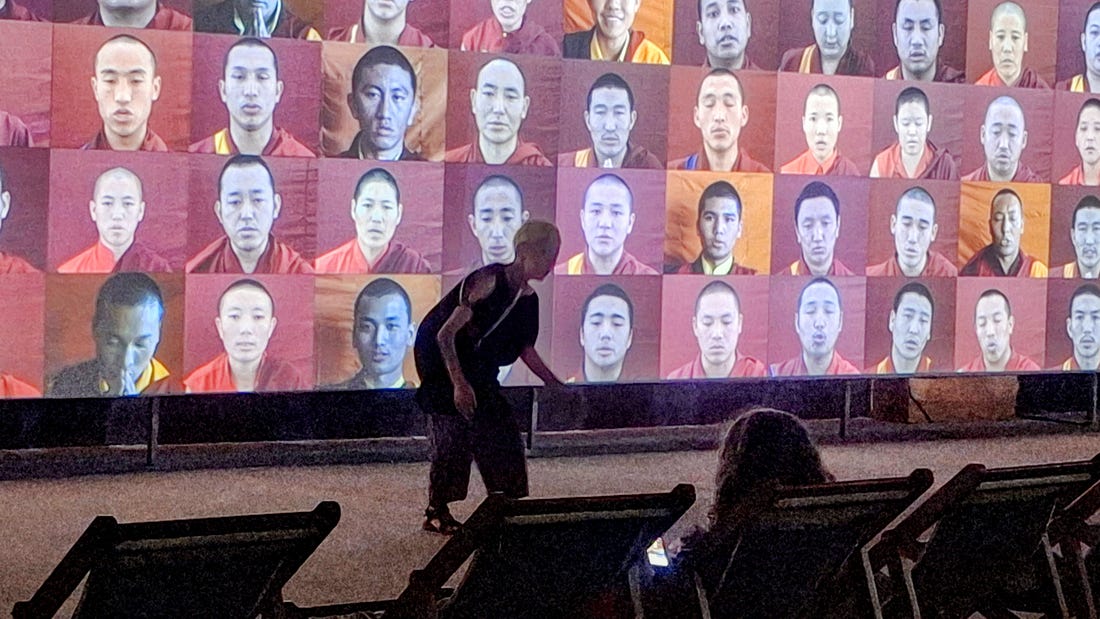
A multi-channel installation, Waterfall, which is on display at the biennale’s Island Warehouse, shows 108 monks across genders chanting the Heart Sutra with just a slight delay between each video recording. The result is indeed a waterfall of rhythmic chants, which washes over a listener (viewer). The site of the installation lends itself well to the acoustic and visual impact of the work. Describing her 2003 piece, Abramović said that she decided to put deck chairs before the large installation, as “that is how you bring [the age-old ritualistic learning] into the present”. Separately, Abramović has also made several trips to Brazil, engaged in shamanistic rituals and other healing practices, all in an effort to take on new perspectives on human energy. She has spent time in different mines to source crystals, such as quartz and amethyst, for new versions of Transitory Objects [her artwork], to activate the body’s three basic positions — sitting, standing, and laying. “I think we live in an age which faces an emergency: our consciousness is completely separated from our sources of energy,” she writes. For someone who might have never heard of Abramović before the lec-dem on Tuesday, all of this might seem too on-the-nose. Couple that with some of the clips that the artist showed and what we get is a documentation that simply does not do justice to the profound impact that Abramović has had on the way the world views performance, modern art and the interplay of intellect, emotion and raw physical energy. Needless to say, some of Abramović’s formulations can seem quite outlandish. Take for instance what she writes in her book, Walk Through Walls: A Memoir (2016):
Or this:
The thing is, it works. As one critic (and friend of Abramović) put it, “Marina can actually transform and direct thoughts. She understands and uses the ecstatic. An intensely physical person, she combines it with the spiritual in a completely unique way.” One of the primary reasons Abramović is so renowned is because her performances explore the edges of reason, taking the viewer to the very limit of their humanity. She did this knowing full well that pain, harm and even possible death lay ahead of her. Take for instance ‘Rhythm 0’, where she laid out 72 objects ranging from a rose to a gun, and invited the audience to do anything to her using any of these objects. And they did. Someone stuck pins into her. Another slowly poured a glass of water over her head. A third cut her neck with a knife and sucked the blood — she still bears that scar. One man loaded the pistol, placed it in her right hand, and moved it towards her neck. He was stopped before he pressed her finger on the trigger.
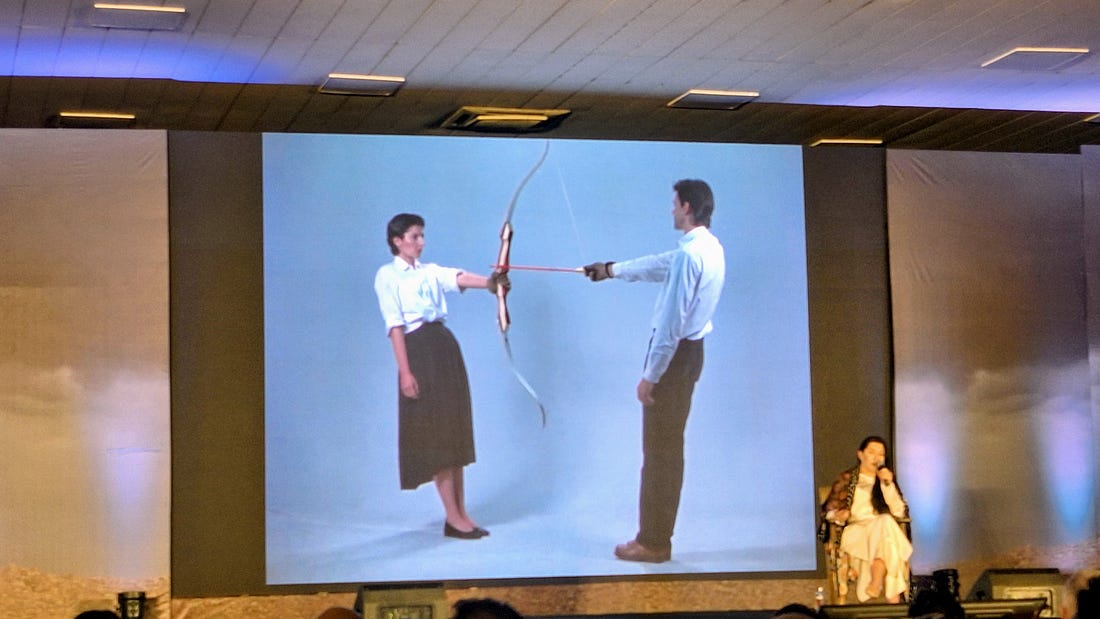
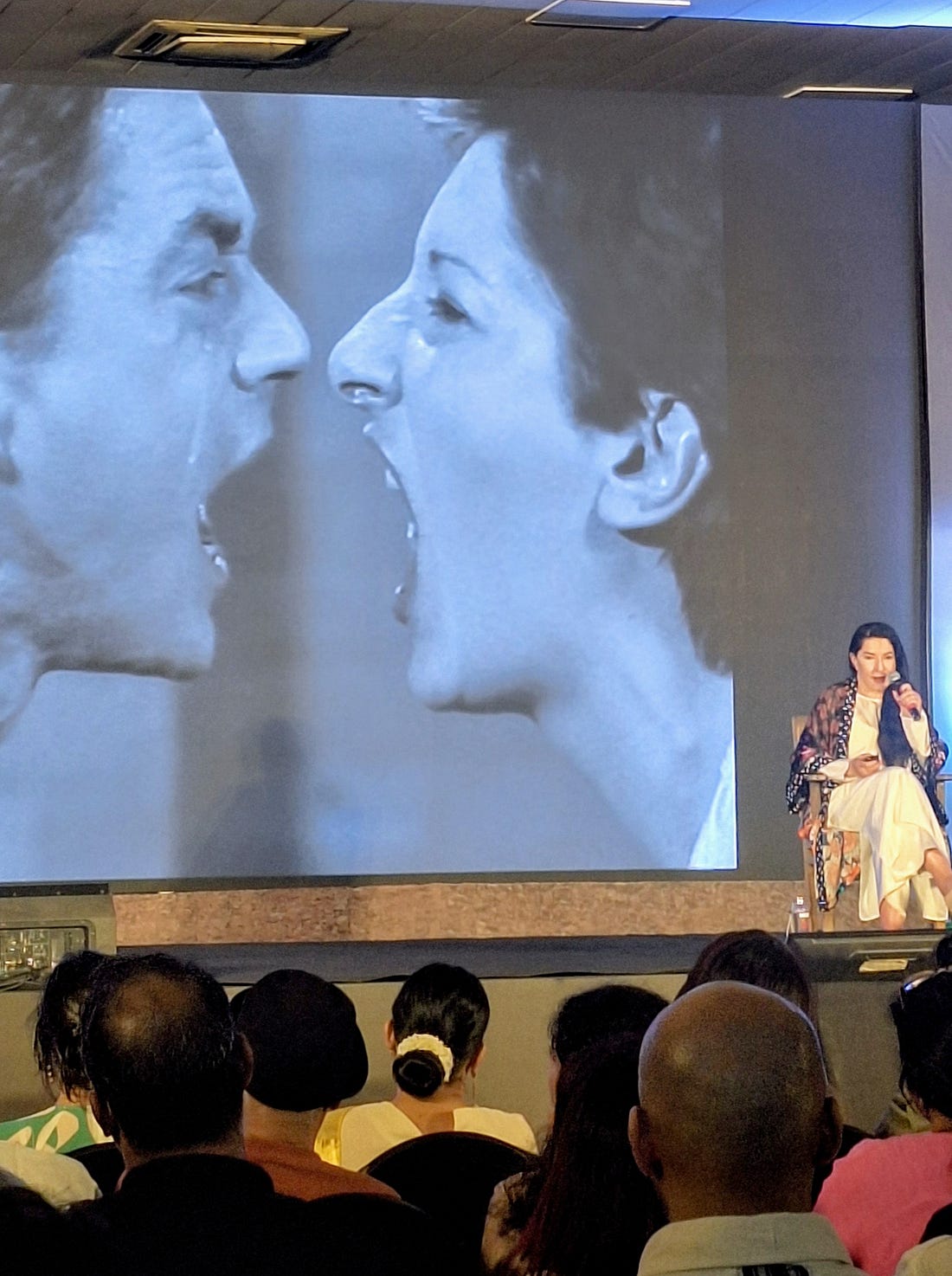
In a series of performances that she did with Ulay, her partner in life and art for more than a decade, she explored the limits of her own endurance using not just her emotional bond with Ulay but also their physical attraction to each other. Indeed, the two of them co-wrote a manifesto, Art Vital, soon after they met in the mid-1970s, which read as follows:
In other words, art is life, and life is art. When she and Ulay parted ways in 1988, they did it in the midst of a gruelling performance, which involved walking the entire length of the China Wall from opposite ends, with an aim to meet in the middle. Needless to say, Abramović was devastated. A new direction emerged in the way the viewer entered her work — not simply as a force field to reflect her energy (her words) but as a participant who needed to be guided on how to direct their own energies. In the 2000s, she did three long durational pieces which cemented her ability to direct the thoughts of viewers and signalled a shift towards increased participation:
“There was something in those moments that made me feel all of my work, over my whole career, had been worth it. In 512 Hours, I found proof of the transformative power of performance. I also understood that this was the time to transfer my own experience to everyone else—and that the only way to do this was by letting people see and feel these things for themselves,” she wrote in her memoir. Although Abramović remains one of the most sought-after performers in the world today and her works (photographs and videos of performances) are part of several significant collections including the Solomon R. Guggenheim Museum in New York; the Centre Georges Pompidou in Paris and the Stedelijk Museum of Amsterdam, she contends that performance art is still to find acceptance as a form of art. Part of the reason is that performance is a kind of immaterial art, and it is highly conceptual. Abramović’s concept of the unity of mind, spirit and body, however, is part of a larger cultural zeitgeist that she no doubt contributed towards making. She forces us to see that art can exist beyond the canvas, and the body can be worked to as much of a degree as you need. Dhamini Ratnam is culture editor at Hindustan Times. Ways of Seeing is her weekly newsletter that takes you through only the most important cultural happenings you need to know of. You can write to her at dhamini.ratnam@htlive.com or comment on this newsletter below. Edited and produced by Tushar Deep Singh.Thanks for reading Ways of Seeing! Subscribe for free to receive new posts and support my work.
|
शनिवार, 14 फ़रवरी 2026






0 टिप्पणियाँ: