
On puppets, strings-pullers, and creating space to think about oppression (but not in that order)A common thread binds Prabhakar Kamble’s ‘Human in Una’ and Dadi Pudumjee’s ‘Amrita Sher-Gil: A Life Lived’ in more ways than one.
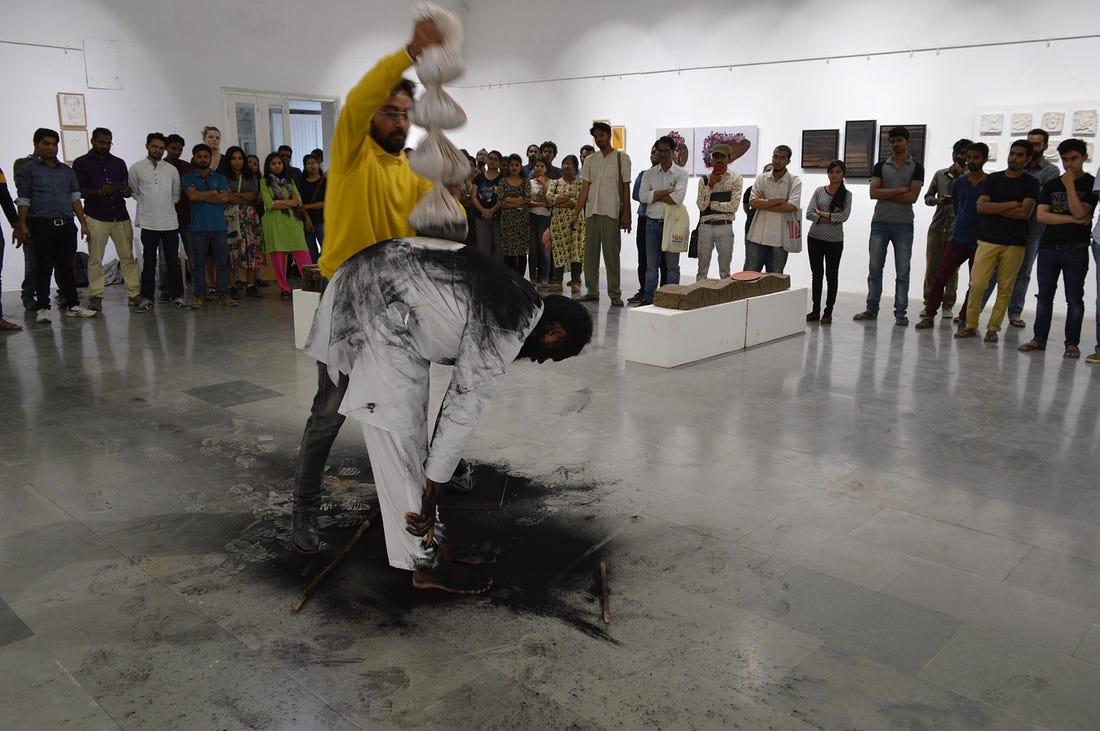
In July, it will be 10 years since a family of Dalit tanners was publicly flogged and humiliated in Una, Gujarat, by self-styled cow protection vigilantes. Spurred by that horrific instance of oppression, Prabhakar Kamble made it his mission to bring systems thinking into systemic violence. Exactly 10 years ago, Prabhakar Kamble stood in the centre of a room in MS University of Baroda, in a stance that resembled a student being punished—back bent, hands straining to touch his toes, eyes cast downwards. Soil, tied up in white muslin cloth in tiers, balanced on his back. Kamble stood unmoving, object-like, inviting the viewer to do anything to him with a tall bamboo staff and a mound of black powder that were placed beside him. Over the course of this piece of performance art, people smeared powder on his face and feet and threw it over his pristine white kurta-pajama. They struck him on his legs, back, hands and feet with the lathi. Kamble winced but didn’t break his stance. 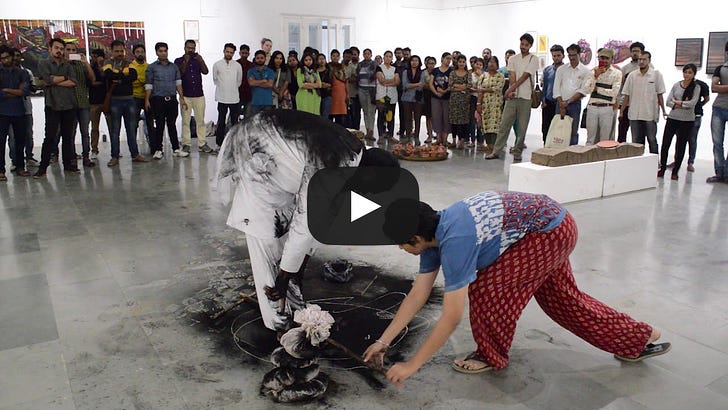 The performance titled Human in Una was Kamble’s response to an incident that took place on 11 July 2016, when seven members of a Dalit family from Una in Gujarat’s Gir Somnath district, were attacked by vigilantes who accused them of killing a cow. Babu Sarvaiya and six other members of his family were thrashed; the assailants tied Babu’s sons and nephew to a car, beat them with iron rods and paraded them half naked as they walked their victims to the Una police station. The family, which had procured the carcass from a nearby village, were tanners and belonged to a Scheduled Caste community. The incident sparked wide protests against caste atrocities around the country. Kamble first performed this piece in Kankavali in Maharashtra, on the invitation of Akhand Lokmanch, a social organisation. He has subsequently performed it a number of times, including in Delhi in 2022. To be fair, correlation is not causation. Simply because an art school student chose to hit Kamble behind his knees during the Baroda performance, or a young woman chose to apply black powder on his face in the Kankavali performance, does not imply that they are casteist. But proving casteism wasn’t Kamble’s end goal here. “I was interested in examining the kind of emotive relation that people have with the materials and objects [used in the performance]. How do they allow themselves to use a lathi or black powder on another person?” Kamble said. This examination is powerful because it is immediate. To quote the globally renowned Slavic performance artist Marina Abramovic, who spoke at the Kochi Biennale recently, performance art differs from theatre because it is not rehearsed and scripted. Performance art is born in the moment. Often, it is subject to the participation of the viewer. It makes the viewer think on their feet and react in real time. Kamble, who attended Abramovic’s talk and was struck by this observation, works precisely in this space of thought-realisation.
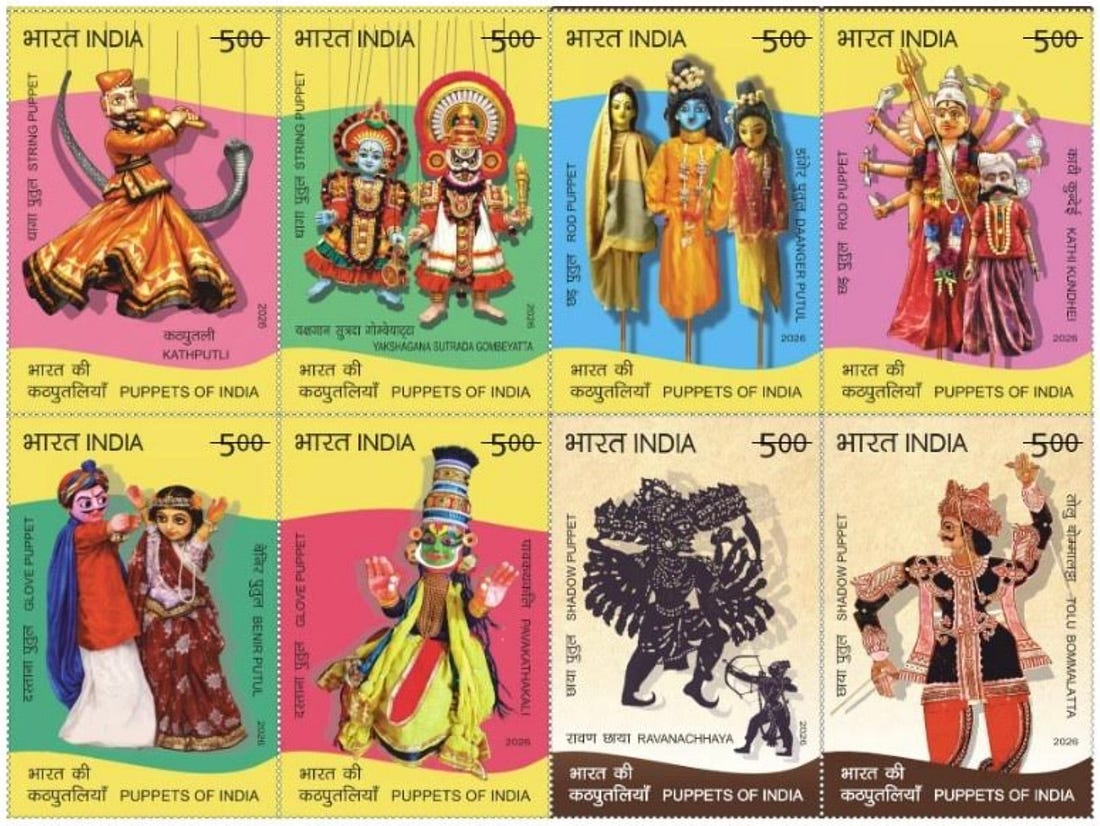
Kamble, one of the co-founders of the Secular Art Movement that aims to use artistic practice to challenge hierarchies that are prevalent across religions, also imbued his performance with symbols. The soil balancing on his bent back is tied up in tiers of cloth to represent the varnas of the caste system. The lathi and the black powder hark to the violence and humiliation of caste oppression. The viewer’s response is an indication of their own thoughts on caste: Are they blind to the symbology and the impact of their choices? Are they embarrassed by the sight of someone bending, giving themselves up to be beaten? Are they excited by the opportunity to participate in a performance of violence? What would you have done, if you were in that room in MS University Baroda? And more importantly, why? Talking of puppets — because, yes, that is an apt metaphor of how we behave as a mob committing systemic violence — if you’re in Delhi and fancy seeing some well-produced puppet theatre from around the world, the Ishara Puppet Theatre festival of 2026 is underway at the International Habitat Centre. I am looking forward to viewing festival organiser Ishara Puppet Theatre’s Amrita Sher-Gil: A Life Lived, designed and directed by Dadi Pudumjee (who is an institution in his own right), on Sunday, which also happens to be the final day of the festival. Pudumjee’s choice of subject is remarkable not least because it flies in the face of what we think we know about puppetry in India. The Department of Posts released a set of eight commemorate stamps last week, one for each of the main traditional puppetry forms of the country: Kathputli (Rajasthan), Yakshagana Sutrada Gombeyatta (Karnataka), Daanger Putul (West Bengal), Kathi Kundhei (Odisha), Benir Putul (West Bengal), Pavakathakali (Kerala), Ravanachhaya (Odisha) and Tolu Bommalatta (Andhra Pradesh).
But Pudumji will use actors, video, and classical music alongside puppetry forms to narrate the early 20th century artist’s story. Sher-Gil was no ordinary woman: Born into privilege, chucked out of art school in Paris for painting nudes, she left the West to return to India, keen to seek a different artistic idiom. Her works from the 1930s are an important document of the quotidian in the Indian subcontinent, her subject often being the silent angular body of the poor, submissive, patient, and with rich interiority. Even a century ago, artists in the country couldn’t but train their gaze on the experience of oppression. Dhamini Ratnam is culture editor at Hindustan Times. Ways of Seeing is her weekly newsletter that takes you through only the most important cultural happenings you need to know of. You can write to her at dhamini.ratnam@htlive.com or comment on this newsletter below. Edited by Dhrubo Jyoti. Produced by Tushar Deep Singh.Thanks for reading Ways of Seeing! Subscribe for free to receive new posts and support my work.
|
शनिवार, 21 फ़रवरी 2026





0 टिप्पणियाँ: