
🧠 Neural Dispatch: OpenAI needs a favour, Mustafa Suleyman’s superintelligence vision, and Amazon’s tiff with PerplexityThe biggest AI developments, decoded. November 12, 2025.
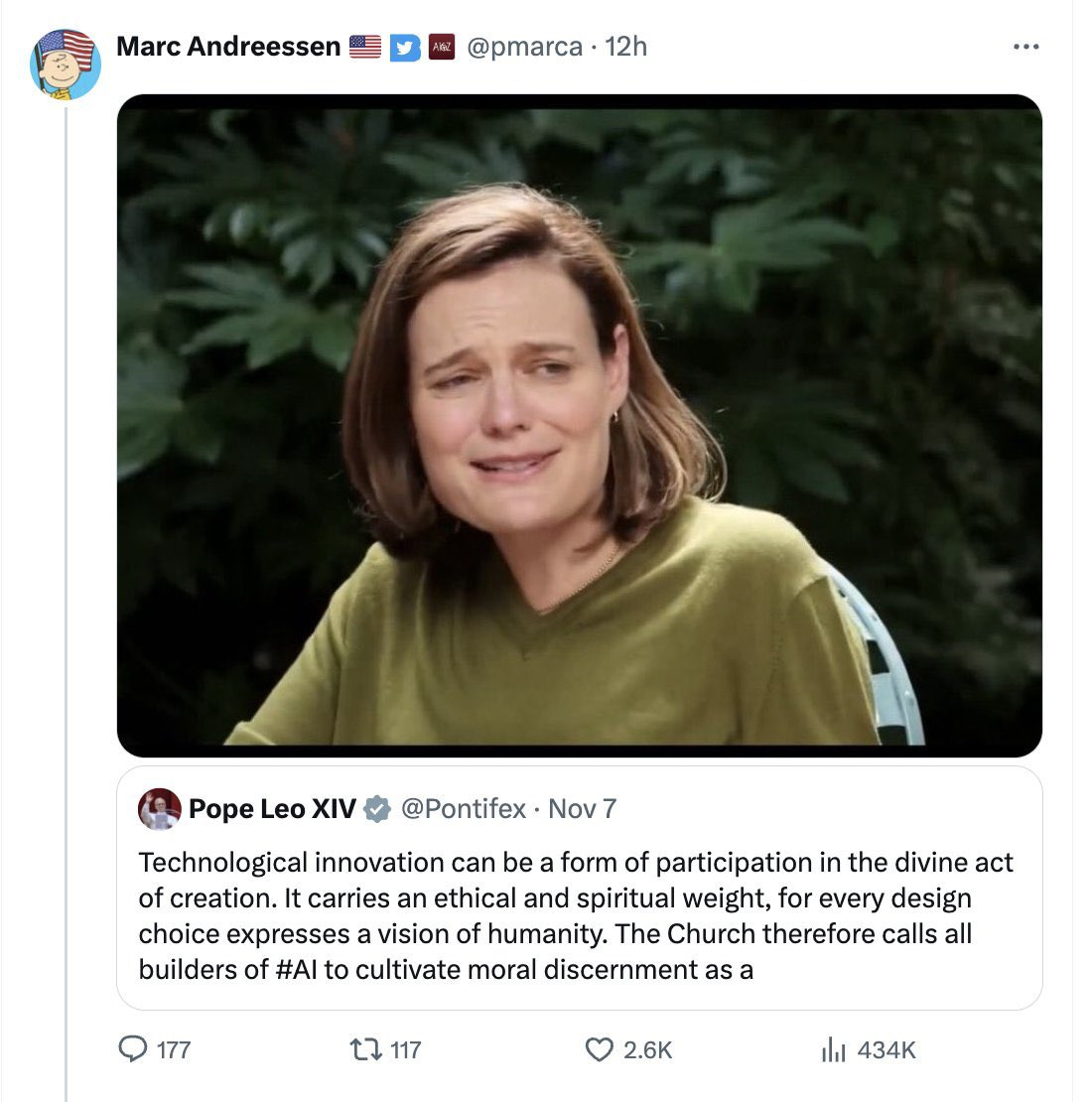
Hello! Cognitive warmup. You know they know the game’s up, but the arrogance is overpowering. Marc Andreessen, the co-founder of the venture capital firm Andreessen Horowitz, thought it was prudent to mock (in a retweet, with Pope Leo XIV, the head of the Catholic Church, after he called on AI makers to “cultivate moral discernment” as a fundamental part of their work. Of course, since it is Andreessen, there is an (un)healthy Sidney Sweeney obsession (though he also seems to have the EU’s Thierry Breton living rent free in his head). It is good to see Pope Leo XIV directly address the AI bros and tell them straight. Which of course the Silicon Valley folks, mostly CEOs and VCs, often don’t like. Not someone who can be brushed aside either, though Andreessen tried. This is just symbolic of where AI is, the bubble becoming clearer. Sam Altman’s OpenAI pretty much requested for the government’s guarantees on the AI company’s loans, the latest in that chapter of things going pear shaped rapidly. The frustrations are clearly showing. Has anyone tried telling the AI bros “Thou shalt not steal”?
ALGORITHMThis week, we have a conversation about Microsoft’s intention for building superintelligence that keeps humans at the top of the so-called food chain, Amazon being absolutely unimpressed with Perplexity’s Comet agentic browser behaving like a human on its shopping platform, and the rising cost of electricity thanks to AI. Thanks for reading Neural Dispatch! Subscribe for free to receive new posts and support my work. Superintelligent AI dreams
Microsoft AI, though too early to know for sure, suggests that their vision for superintelligence is to “ensure humanity remains at the top of the food chain”. I wouldn’t have given this much credence otherwise, but for the fact that Microsoft AI head Mustafa Suleyman is saying it, detailing what he calls Humanist Superintelligence or HSI. “We want to both explore and prioritize how the most advanced forms of AI can keep humanity in control while at the same time accelerating our path towards tackling our most pressing global challenges,” he says, talking about the newly formed MAI Superintelligence Team. Two global challenges that Suleyman talks about — medical superintelligence, and optimising workflows to make them more energy efficient. Impressive vision, we’ll celebrate when even a fraction of this is tangibly achieved, without putting humans at a disadvantage. For one, AI companies could start by defining ‘consciousness’ first, a key in finding balance between humans and AI’s impedance. Electricity costs, and political victories
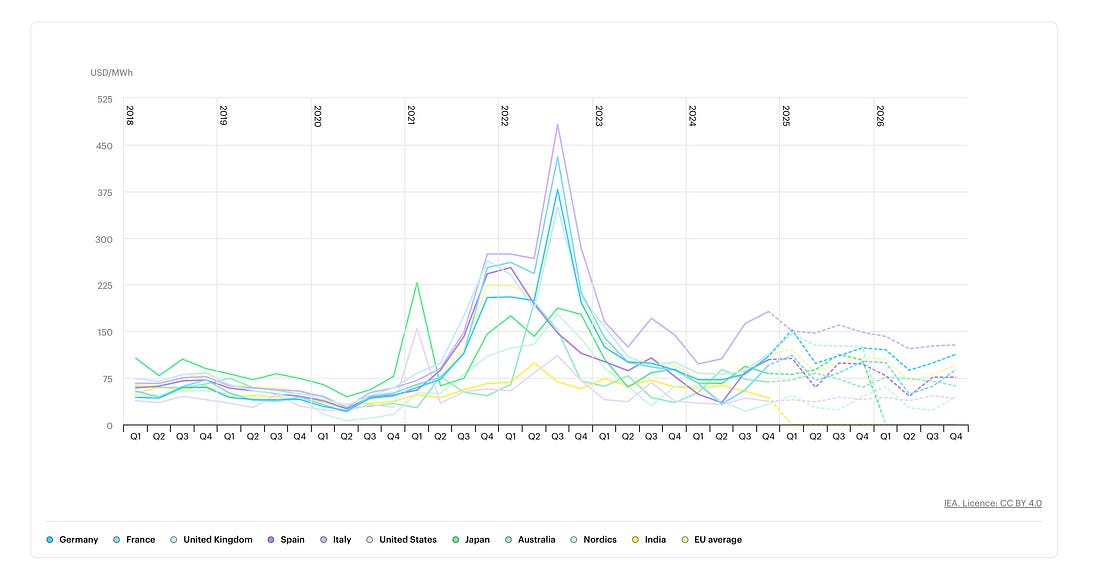
There is a growing sense that soaring electricity prices in the US dictated results of the recent elections in New Jersey, Virginia, and Georgia. A lot of credit for rising utility bills lies at the doorstep of AI data centers, as well as electric motoring. Enough data suggests as much. A forecast earlier in the year by International Energy Agency (IEA) indicated that the US electricity demand to grow at an average annual rate of about 2% over the period 2025-2027. The latest census data in the country illustrates that every one in three US households has reported forgoing necessities, such as food or medicine, to pay household energy bills. There is also data that New Jersey has seen one of the largest spikes, with retail rates jumping as high as 20 percent this summer. At a time when the AI bosses are only talking about trillions of dollars of investment in data centres, the citizenry that’s already struggling with rising costs of sustenance, is clearly getting fed up with billionaires preaching the benefits of AI. Now, the political candidates who have won the elections, will be held equally accountable if they don’t deliver an improvement. A champion of AI, unimpressed with agentic AIAmazon has sued Perplexity AI over its new Comet, the AI browser, which has the habit of autonomous browsing and an assistant tool that can supposedly do many things. Amazon alleges that Comet can log into a user’s Amazon account and attempt to place or modify orders while disguising itself as normal human traffic. In legal terms, Amazon’s lawyers say Perplexity’s trespass involves code rather than a lockpick. Perplexity would most likely call this innovation of some sort. I wouldn’t know, I strictly keep my distance from AI browsers — there is very little to trust down that path. Interestingly enough, Amazon too has developed some level of agentic AI on its shopping presence — there’s “Buy For Me” in some markets which lets users shop within its app, as well as the Rufus AI assistant (it shows prominently on the app in India too) that can recommend items and manage carts. THINKING“I want to clarify my comments earlier today. OpenAl is not seeking a government backstop for our infrastructure commitments. I used the word “backstop” and it muddied the point. As the full clip of my answer shows, I was making the point that American strength in technology will come from building real industrial capacity which requires the private sector and government playing their part. As I said, the US government has been incredibly forward-leaning and has really understood that Al is a national strategic asset.”
There is something almost poetic about Silicon Valley’s new-found patriotism. The same industry that once prided itself on being ‘borderless’, and had an aura of being too busy inventing the future to deal with government paperwork or regulatory hassles, is now shaking Washington’s gates with the subtlety of a brass band. They’ve one tiny favour to ask — please underwrite our trillion-dollar ambitions. Not to interfere, of course. Just to catch the inevitable free-fall. They know it’s coming. They know it’s a bubble. OpenAI’s CFO, no matter how much she may try to backstop the backstop, wants the US government to guarantee the mountain of financing they (and their creative investment partners such as Nvidia, Oracle and AMD will need) to further inflate the bubble as much as it’d go. Or in other words, to apparently build its future GPU infrastructure empire. The logic that we are loudly hearing from OpenAI and the likes of Jensen Huang (who has seemingly paused his ‘lets make a deal’ world tour to make the plea) goes something like this — AI is too strategically important to fail, America must lead, and therefore taxpayers should be morally prepared to pick up the cheque if the math doesn’t math. And while we’re here, could the Treasury perhaps fill out the loan guarantee form in triplicate? The OpenAI and Nvidia tag-team is very visible. The context: The AI bros seem to be channeling the tech era version of their inner Founding Father vibes. Suddenly, GPUs are the new railroads. AI clusters are national projects. Silicon is a symbol of sovereignty. The marketing copy writes itself. There’s even a little flag-waving flourish at the end — If we don’t build it, China will. You don’t want that, do you? Specific to OpenAI is the illusion Altman has tried to create — that they’re too big to fail. If ever such a thing existed. And even more so in this case, where the company is yet to turn a profit in its existence, has been creatively circling investment money as if no one is noticing, and absolutely botched the latest models which were supposed to usher in the “PhD-level intelligence” era. They still stumble over basic math. Some interesting numbers — this AI company lost $13.5 billion on $4.3 billion in revenue for H1 2025. The AI industry has been burning money at a rate that would make WeWork’s accountants blush. The capital expenditure required for model training, inference infrastructure, and chip supply isn’t merely high — it’s almost vertical. A realisation has dawned that private capital alone won’t shoulder national AI infrastructure, to the tune of billions of dollars. The new plan, probably thought of in a San Francisco coffee shop (that’s how deals are mostly done in that part of the world) is to palm off the risk as patriotic duty. This takes me back to 2023 when Altman, at a summit said, “It’s hopeless to compete with us”. A Reality Check: When an industry truly believes in its future, it takes its own financial risks. In the case of AI, that is absolutely not the case, and therefore the subtle movement to palm it off to the unsuspecting public to absorb them. The request for backstops is not a declaration of confidence. AI companies, be it OpenAI, Nvidia, Oracle, AMD, Anthropic, Meta and Microsoft, are essentially writing a confession that they have no idea what they’re doing, that whatever they are doing is costly, and let’s see where this takes us, as long as you split the bill. If this bubble holds, Silicon Valley will be hailed as the vanguard of a new technical era. If it doesn’t, taxpayers will be left holding the bag. “We tried”, we’ll be told. Heads they win, tails you pay. I rarely ever agree with a politician (or an AI bro, as things shape up), but must say, it is hard to disagree with Florida governor Ron DeSantis, “My solution is not to bail out big technology companies.” Neural Dispatch is your weekly guide to the rapidly evolving landscape of artificial intelligence. Each edition delivers curated insights on breakthrough technologies, practical applications, and strategic implications shaping our digital future. Written and edited by Vishal Mathur. Produced by Shad Hasnain.Thanks for reading Neural Dispatch! Subscribe for free to receive new posts and support my work.
|
मंगलवार, 11 नवंबर 2025








0 टिप्पणियाँ: