
🧠 Neural Dispatch: Decoding Adobe Premiere for iPhone, defining real jobs, and cost of ‘free’ AIThe biggest AI developments, decoded. November 5, 2025.
Hello!
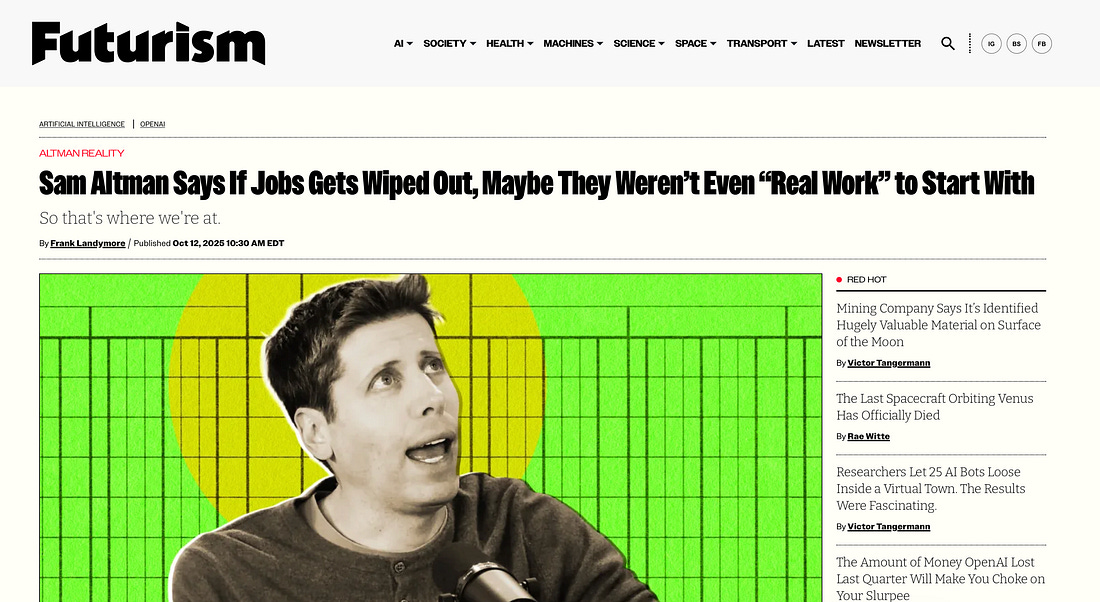
Cognitive warmup. The man many credit as the one leading the AI revolution (I certainly don’t; will refrain from getting started on that), Sam Altman, said recently that if AI wipes out some jobs, maybe they weren’t even “real jobs” to begin with. Who is Altman talking about? Law enforcement? Medical professionals? Lawyers and legal experts? Journalists? Creative professionals? The mail man? I am sure the CEO and their chosen favourites will be safe from the mass AI experiments that enterprises worldwide are slowly burning their fingers with. This is the same Sam Altman, who in a recent podcast was asked about how his $13 billion not-for-profit can support a claimed $1.4 trillion of spend commitments, and he went on the defensive, blaming some non-existent short sellers. Mind you, an OpenAI IPO has been speculated for a while. What if tomorrow AI decided Sam Altman was redundant? It must be peaceful in the Altman-reality. ALGORITHMThis week, we chat about yet another research paper that calls out AI’s security nightmares, decode what a ‘free’ AI subscription plan really means, and what Figma’s latest acquisition means. Thanks for reading Neural Dispatch! Subscribe for free to receive new posts and support my work. LLM Security, as yet unsolvedA new paper titled The Attacker Moves Second: Stronger Adaptive Attacks Bypass Defenses Against LLM Jailbreaks and Prompt Injections (you can read it here), confirms an uncomfortable truth — the issue of large language model security is far from solved. Researchers from Northeastern University, ETH Zürich as well as AI companies Google DeepMind, OpenAI and Anthropic, tested 12 robust jailbreak and prompt-injection defenses, only to find all of them crumble when faced with adaptive adversaries, both human and LLM-driven. Real cost of “Free” Gemini AI for Jio users
There was a time when data was the new oil. Now a blind rush makes AI everything…oil, data, gold, whatever you want to make of it. Indian telecom companies are rushing to bundle AI in the hope that it increases average revenue per user (ARPU). That is any telecom player’s holy grail, ever since I have been following this space since the late 2000s. After Airtel and Perplexity’s bundle caused excitement a few weeks ago, I would note that the social media excitement (usually led by the thread enthusiasts kinds) around Reliance Jio and Google Gemini AI Pro bundle, was getting a bit much. As generous as it sounds on paper (an 18 month bundle does pip Airtel’s 12-month bundling of Perplexity’s plan), you have to factor in a cost at the end of this period. At this time, Jio says the early access is available for users on the “unlimited 5G plans”, and aimed at a younger demographic of mostly students. The most cost effective of these unlimited 5G plans works out to ₹349 with a 28-day validity and 2GB data per day. That simply means over an 18-month period, you’re shelling out ₹6,282 (that’s ₹349x18; you’d be better off with the ₹3,999 + ₹1,799 plans instead, if there is a certainty about the long term) or thereabouts to remain eligible for this offer. There’s the cost, there’s the aspect of having to stick around (Jio would find your ‘loyalty’ priceless, for sure) and the need to recharge regularly (one skip, and the offer breaks). Smart marketing and smart maths, but you’ve to work out if the calculations work for you. Post that 18-month period, all illusion of ‘free’ would disappear too, and you’d be shelling out close to ₹19,000 per year because the Google Drive storage would inevitably be filled much beyond the 15GB free limit and you’d have surrendered all your thinking to AI. Figma’s Weavy move, towards a creative engine
Figma has acquired Weavy, an AI-powered node-based (this means a visual, flowchart-like interface where creative processes and effects get listed individually) media generation platform that blends image, video, and animation tools. This signals Figma’s intent to evolve beyond static design into full-spectrum generative creation. Weavy’s tech enables multi-model composition, which gives an ability to designers mix generative models, tweak parameters, and build layered, editable results instead of one-shot outputs. Think of it as the creative workspace evolving into something where design, iteration, and storytelling coexist. The future of design may not be about replacing imagination, but about making it much more editable. Last time on Neural Dispatch: Agentic AI’s lack of intelligence, a DeepSeek moment, and Nvidia’s AI supercomputer PROMPT
Adobe Premiere Comes to iPhone, and editing on a mobile device finally gets really powerful. Much beyond those Instagram Reel focused apps that litter the App Store. Adobe has quietly pulled off quite something here. A proper version of Premiere on the iPhone. This isn’t that typical cool, casual and eccentric mobile-first editing app, of which there seem to be many, appealing to the Reels crowd. Adobe is no stranger to pulling off powerful mobile apps that don’t compromise on capabilities — Lightroom is a personal favourite, as is Project Indigo, something I’d written about recently. This one has the Premiere Pro name to live up to, and therefore includes multi-track editing, layered audio, full-resolution 4K HDR export, AI-powered background removal, and animated captions that can actually keep up with your voice. In short, this isn’t a toy for Reels, but a full-fledged editing suite. Expect it to get even more powerful features, in due course. For now, it is free to download and edit on, without any limitations or features being pushed behind a subscription wall. But you would need to pay for Firefly, for credits, if you wish to use generative AI features. The move makes perfect sense. If your workflow already lives on your phone (that is shooting, scripting, and posting) then dragging footage to a desktop every time would feel like a creative tax. The ability to colour-grade, trim, add text overlays, and even clean up your audio (the Adobe Podcasts brilliance has made its way here), all add credence to Adobe Premiere’s push for relevance. The app syncs seamlessly with your desktop Premiere too, just in case you’d want to pick up on where your thumb left off. Android phone users, in case you’re wondering where all this leaves you, Adobe says there are plans for an Android version of Premiere too at some point. Keep waiting. Do check out my other newsletter, Wired Wisdom: Adobe’s AI avenue, Asus presumptuous console pricing, and pondering brain rot THINKING“Creativity is a balance of innovation and imagination, technology and humanity. We will provide the tools, platforms, and integrate with the ecosystems, to empower creators, to unleash their boldest imagination. We’re blending AI with ingenuity and in intuitive ways.” It’s a statement that goes beyond Adobe’s product playbook. It’s a worldview, a balanced one, at a time when the AI companies are simply talking big numbers and even bigger promises. Narayen’s emphasis on ecosystems, not individual tools, defines where at least the creative-focused tech is heading. The future of creativity may well lie in how seamlessly human intent blends with AI, not how powerful AI is to decide on the human’s behalf. For anyone crafting in this era — be it a journalist, designer, filmmaker, coder — the real question isn’t “can AI do this?” but “Can my ecosystem make me faster, free-er, and express better?” That, as Narayen puts it, is where technology meets humanity.
The Context: At Adobe MAX 2025, Shantanu Narayen reframed the creative industry’s AI conversation. It is not a battle of algorithmic supremacy but one to find a fine balance between imagination and technology. His ecosystem positioning finds an example within Adobe’s own suite, from Firefly to Premiere to Express, which should be able to behave as one adaptive, creative platform, one that can talk to each other when a user so needs it to. In Narayen’s framing, the company’s value isn’t the AI itself, but as a connective tissue that lets humans and machines co-create with less friction. A Reality Check: It’s easy to romanticise that balance of AI and ingenuity with the real challenge being in maintaining authorship and creative authenticity as automation deepens. The more generative systems assist, the more they risk blurring ownership and originality — especially when AI handles the polish as much as the production. Adobe’s vision will hinge on whether creators feel empowered by its agentic tools, or feel sidelined. True creativity thrives not just on accessible technology, but on maintaining the distinct human fingerprint Narayen insists will remain central. Time will tell us whether Adobe’s approach has succeeded, or tweaks must be made. Neural Dispatch is your weekly guide to the rapidly evolving landscape of artificial intelligence. Each edition delivers curated insights on breakthrough technologies, practical applications, and strategic implications shaping our digital future. Written and edited by Vishal Mathur. Produced by Shad Hasnain.Thanks for reading Neural Dispatch! Subscribe for free to receive new posts and support my work.
|
मंगलवार, 4 नवंबर 2025









0 टिप्पणियाँ: