Roy, Arya said, was one of two photographers present during the signing of the Constitution of India on January 24, 1950. Roy was also there when Gandhi made a tour of the North West Frontier Province in 1938, as well as when the Cabinet Mission talks took place in Simla for the transfer of power from the British to an independent Indian state.
I was struck by historian Indivar Kamtekar’s chapter at the very start of the book, where he offered an alternative way of seeing the history we have grown up with. In Roy’s photographs, as in the work of journalists, creative writers, film-makers and historians of the time, Kamtekar finds a common thread. Together, they built a narrative of Indian nationalism in which “farsighted leaders mobilized millions of people to achieve liberation from British rule, and guided their country wisely thereafter.” What makes Roy’s images valuable is how he, like the others around him, embodied the optimism of the first decades of independent India, never letting us feel that “history was headed in the wrong direction”. Instead, these images assured us that India’s history was “in the control of great and wise men.”
Consider instead, Kamtekar writes, a parade of alternative images that highlight what has been marginalized, excluded or misrepresented: “Shops and houses being locked up as people fled Calcutta in panic, because they feared Japanese bombing. The gold in the vaults of the Reserve Bank of India being removed away from Bombay for the same reason. The false alarm that the Japanese were going to land early one morning on the beaches of Madras… Young Indian men queuing up to enlist in the British Indian Army… Poor Bengali agricultural labourers starving on the streets of Calcutta. Punjabi peasant women showing off silver ornaments which wartime prosperity (due to military remittances and high agricultural prices) had allowed them to buy. Despondent Congress leaders languishing in prison cells (as most did from 1942 to 1945). The British governor leaving by the back entrance as crowds ransacked his mansion in Calcutta on Independence Day in 1947. The departing governor of Punjab looking down from the window of his aircraft at the smoke rising from burning cities and villages during the partition riots.”
Roy did not capture any of this at the time.
To be sure, his visual archive never set out to be the complete history of India at that crucial juncture. Around the globe, World War II had wreaked destruction. The atomic bomb had killed and maimed millions in Japan, as did Nazi Germany’s anti-Jew agenda in Europe. Anti-colonial movements were rife in the Asian and African continents. In India, a deadly famine in 1943 had wiped out millions of lives in Bengal due to hyperinflation caused by the world war. A few years later, the Partition caused communal bloodletting and mass migration the likes of which the subcontinent had scarcely encountered before.
It suited those in power to appear to be in control, especially at a time when the whole world seemed to be coming apart at its seams. Helping them do so was the cleverly deployed image, whether as a newspaper photo or a post-card or even a poster. For the British colonial masters, these images spelt doom. “From the announcement of photography in 1839 until (very roughly) the beginning of the 20th century, photography was perceived in India — by agents of the colonial state — as a cure. As the 20th-century progressed, however, photography was increasingly viewed as a curse, or poison. Deployed by agents other than the colonial state, it revealed its dangerous ability to store evidence of a problematic kind,” writes anthropology and visual culture professor Christopher Pinney in Seven Theses on Photography.
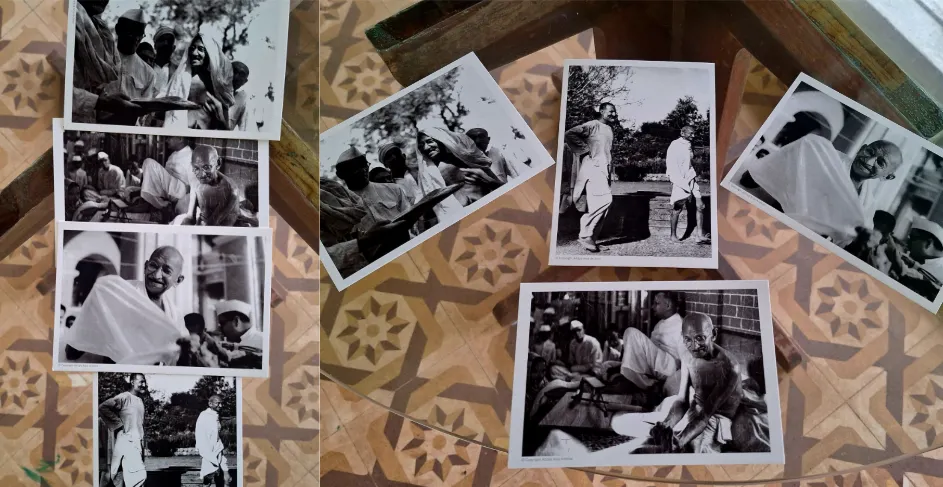
Gandhi, for instance, sent out autographed postcards to those he corresponded with. They eventually became collectibles — next week, Anand T Hingorani’s collection of photographs, postcards, letters, books and other memorabilia, will be brought under the gavel of the Mumbai-headquartered auction house, Saffronart. Hingorani was a freedom fighter and a close associate of Gandhi, and compiled, edited and published many of Gandhi’s writings. Part of his collection includes several postcard sized images of Gandhi inscribed with text such as “Bapu ka ashirvad” (The blessings of Bapu). The image became a symbol or a stand-in for Gandhi’s message of independence, swaraj (self-rule), inter-religious harmony and peace.
Seventy-nine years on, they still do.



0 टिप्पणियाँ: