
🧠 Neural Dispatch: AI conversations with DeepMind’s Pushmeet Kohli and OpenAI’s Srinivas NarayananThe biggest AI developments, decoded. December 10, 2025.
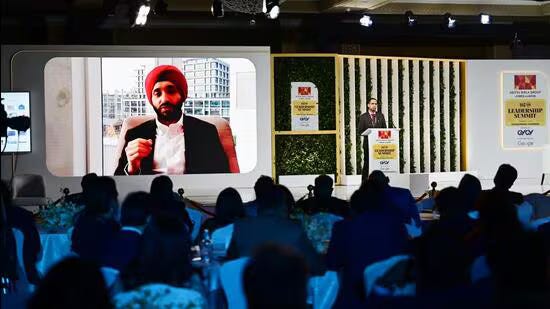
Hello! This week, we have substantial AI conversations emerging from the Hindustan Times Leadership Summit 2025. At the summit, Pushmeet Kohli, Vice President of Science and Strategic Initiatives at Google DeepMind, and Srinivas Narayanan, CTO for B2B Applications, OpenAI talked about the intersections of AI and science, the importance of India to AI’s development and a lot more. Last time on Neural Dispatch: Stressful times for Nvidia’s world view, and AI refuses to take responsibility Thanks for reading Neural Dispatch! Subscribe for free to receive new posts and support my work. SCIENCE AND SOCIETY
“The organisation has science embedded in its DNA. That we do through science, by making progress in many scientific areas, and we have been fortunate to have been able to show the potential of AI in problems such as protein structure prediction with AlphaFold. Our focus is on these problems where AI can have a transformational impact.” — Pushmeet Kohli, Vice President of Science and Strategic Initiatives, Google DeepMind, speaking at the Hindustan Times Leadership Summit. Read: We don’t adopt move fast, break things mentality to AI: DeepMind’s Kohli at HTLS DeepMind’s north star has always been science — not product roadmaps, not quarterly earnings, not active users. Though that too has fallen well into place, as Kohli told the world at HTLS that 180,000 researchers and students are using AlphaFold in India, and that he was certainly surprised by the number of people studying protein structures and cures for disease in the country. In a world where most AI companies oscillate between promising AGI, talking about replacing humans in the workplace, and selling premium subscriptions, DeepMind still wants to be the place that solves the universe’s puzzles, one protein at a time. Kohli’s point lands cleanly — real transformation isn’t a flashy chatbot, it’s breakthroughs like AlphaFold that ripple through science, healthcare, and entire disciplines. DeepMind, at least in aspiration, still positions itself as the lab where science leads and commercialisation politely follows. This sort of a mission is easy to wrinkle though, the examples being of every other AI lab that has more than one claimed to be pursuing scientific goals, but well, we’ve already talked about chatbots and subscriptions. DeepMind, for now, is not being quietly nudged by its corporate hierarchy for boosting revenue streams. But will that moment come too? Google, currently in the “everything must ship” phase of its AI cycle, which makes this focus on a purely curiosity-driven operation, even more credible. For now, DeepMind can continue aiming for Nobel-adjacent scientific leaps while the broader Alphabet machine demands Gemini to answer homework questions faster. AlphaFold was a moonshot success, and if ever there was a hint at revenue pressure, its bought DeepMind a lot more time. DeepMind must be allowed to pursue the next AlphaFold-esque chapter. “The implications in healthcare, in drug discovery, are some things we will see really accelerating. There will be special emphasis on countries such as India, which Kohli believes has a lot of scope in “leveraging AI for healthcare.” When Kohli talks about AI that can have a transformational impact, he’s clear that DeepMind’s moves cannot be incremental but must “transform the way society does something.” That foundation, is as solid as it gets, in the world of AI. Do read my other newsletter, Wired Wisdom: Appreciating Oppo & Hasselblad, Tata Sierra’s return and noting Windows 11’s mess INDIA, AND AI FOR THE WORLD “India is going to be central to how AI is deployed in the real world. And I think it’s one of the amazing things about India is just the energy and the excitement for AI is really high. I talk to people who are building incredibly rich sets of applications, not just for India, but for the whole world.” — Srinivas Narayanan, CTO for B2B Applications, OpenAI, speaking at the Hindustan Times Leadership Summit. Read: India will be central to how AI is deployed in the real world: OpenAI’s Srinivas Narayanan at HTLS In my conversation with Narayanan, it is clear that he is positioning India as not just as another market, but as a critical testing ground alongside being a development hub for practical AI applications. For OpenAI, they need both — new markets and all the help they can get with research. Focus on the phrase “deployed in the real world”, for its key — he’s talking about moving AI from hype to actual utility. India has 1.4 billion people with extreme variance in income, diversity in language and dialects (22 official languages), literacy levels differ, and growing infrastructure. If AI works here, it can work anywhere. Think of this as the ultimate stress test for technology? Look back into the last 20-30 years, and you’ll notice India has a habit of skipping tech and adopting an advanced stage. Skipping landlines for mobile connections. Credit and debit cards never caught on, but UPI’s scale sets a global benchmark. There’s a pattern of adopting new technology rapidly when it solves real problems. AI companies want to ride that wave. Add cost-sensitive innovation and the talent pool advantages, and you see the puzzle coming together. There is a business reality too, behind this statement. Narayanan knows India presents a big market opportunity. The focus has been clear, with the educational partnerships to strengthen foundations and the price sensitivity with the ChatGPT Go subscription tier addressing affordability for the masses. Little many of you may have realised, OpenAI makes money when developers build apps using their APIs. The more Indian developers building means potentially more API calls, and therefore more revenue. They need a thriving ecosystem of platform builders. As an aside, India is still figuring out AI regulation. Getting a strong foothold now, before the finality of rules, is strategic timing. OpenAI, with its India focus, is figuring out many AI intersections. Education and AI, Agriculture and AI, financial inclusion and healthcare. OpenAI is racing against Google, which also has a very, very strong India presence, as well as other AI companies. The hope is to make it enticing enough for Indian developers to build with OpenAI rather than competitors. I’d say this marks a broader pattern. Every major tech company (Google, Microsoft, Meta, name whoever) makes similar bullish statements about India. It’s partly genuine, and partly strategic positioning. They’re all fighting for developer mindshare, market position, and government relationships. The enthusiasm may be real, but so is the calculated business interest. A greenfield opportunity, to build for the world? Neural Dispatch is your weekly guide to the rapidly evolving landscape of artificial intelligence. Each edition delivers curated insights on breakthrough technologies, practical applications, and strategic implications shaping our digital future. Written and edited by Vishal Mathur. Produced by Shad Hasnain.Thanks for reading Neural Dispatch! Subscribe for free to receive new posts and support my work.
|
मंगलवार, 9 दिसंबर 2025







0 टिप्पणियाँ: