
🧠 Neural Dispatch: AI’s biggest risk isn’t sentience, it’s meaninglessnessThe biggest AI developments, decoded. October 15, 2025.
Hello!
Cognitive warmup. If one is to stop looking at the conversation about AI and electricity from the fairly selfish prism of sector specific stock and mutual fund investments, you’d realise how insane the numbers being quoted really are. Recently, OpenAI executives’ estimate a cost of $50 billion per gigawatt for AI computing infrastructure; now Morgan Stanley is projecting 65GW, or gigawatt new data centre demand by 2028. Do the maths, it totals to a cool $3.25 trillion. There may be a time to debate energy scarcity, but clearly, right now is still the time for AI enthusiasm. I don’t always agree with Elon Musk, but he has a solution for this conundrum — he proposes using industrial-scale battery storage to shift power from periods of low demand to daytime AI peaks, potentially doubling the US power grid’s annual energy output. ALGORITHMThis week we talk about the latest big money hiring at Meta, Google making AI Mode available in more countries, and AI generated slop troubling law enforcement too. Thanks for reading Neural Dispatch! Subscribe for free to receive new posts and support my work. Meta’s still splashing the cashA few months ago, the conversation mentioned Andrew Tulloch had supposedly rejected a $1.5 billion salary offer from Meta. Now, the co-founder alongside Mira Murati Thinking Machines Lab, has agreed to join Meta. You must be wondering, how much did Mark Zuckerberg offer him now, but I’ll not digress. Thinking Machines Lab is a research outfit known for its frontier work in scalable training and alignment. With that as the perspective you can see this move potentially underscores Meta’s ambition to turn its open-source advantage (via the Llama models) into something of a genuine research powerhouse. Another chapter to its philosophical intent to compete with the likes of Google’s DeepMind labs, and OpenAI. If Meta’s intention is to infuse a lab and research culture, they couldn’t have done it much better than Tulloch with his researcher-first mindset. With the social network’s AI division already training Llama 5 and big ambitions of scaling infrastructure, Meta’s open-source play seems a long-term bet on ecosystem influence. AI Mode in Google Search is truly global
Google has widened availability of AI Mode in Search, by expanding access to dozens of new languages and markets. 40 new countries and territories will find AI Mode in their search results, which takes the availability map of this feature to over 200 countries. In essence, AI mode brings the Gemini model powered overviews, summaries, and broader context to your search. Google says with AI Mode, they are seeing users “asking questions nearly three times longer than traditional searches”. What works well is the foundation of advanced reasoning and multimodal understanding with the custom Gemini models, which ensures there is better understanding of local language, and something of a grip on nuances. When AI Mode first rolled out, it was clear Google’s intent is to further integrate AI within a familiar Search flow, and goes beyond the AI Overview we see on the top of search results. The future of search isn’t about chatbots or assistants, but context-rich comprehension. Google seems more than ready to preserve its lead. Nuisance economy of AI fakery
AI-generated videos (or as I had called this collective AI generated crap/slop/garbage/junk in Wired Wisdom last week) have fast become digital litter, which is troubling law enforcement too. Kids with generative video apps on their phones are creating visuals of an apparently homeless man in their home, sending it to their parents who inevitably lose their patience (in some cases, call the police in sheer panic), all for posting on a TikTok post for a want of ‘views’. The police in Massachusetts discovered this much to their frustration, having responded to a call from worried parents, which actually turned out to be an AI generated TikTok clip of a supposedly homeless man being harassed. Don’t believe me when I say generative video tools do no good for humanity, but believe it when the Massachusetts police say this — “This prank dehumanizes the homeless, causes the distressed recipient to panic and wastes police resources. Police officers who are called upon to respond do not know this is a prank and treat the call as an actual burglary in progress thus creating a potentially dangerous situation.” There really is very little that seems ethical about AI as things stand, isn’t it? I’ll say this now — AI’s biggest risk may not be sentience; it’s meaninglessness. PROMPT
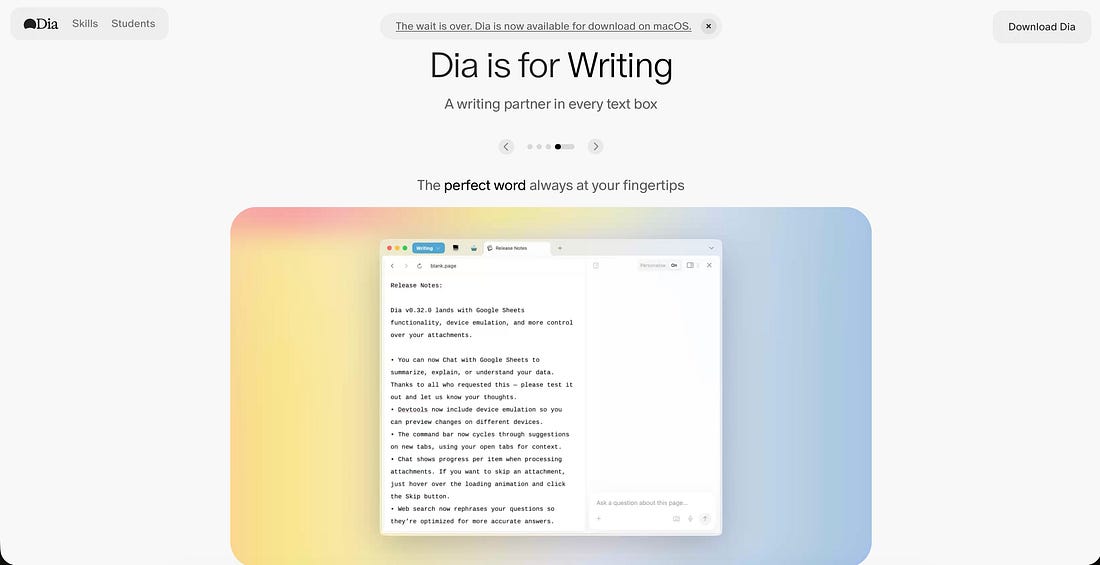
The Browser Company’s Dia browser, with AI at its core, is now available on Mac, and there is no need for invites now. You may have always thought a browser is a window to the goodness of the World Wide Web. The Dia browser, which began the journey of an ‘AI browser’ much before Perplexity, Google or the Opera browser we chatted about last week, and everyone else got in on the fun, is now making the app available on MacOS, and also removing the need for invites. The AI integration talks about certain pillars around which functionality is built — writing, planning, learning and shopping. The integrated AI agent can summarise, translate on-demand, simplify complex concepts, filling forms (I have my opinions on how limited use that is) and even an in-line copy editor for when you need to get some writing done. Install Dia (available on macOS and Windows), sign in, and open any webpage — you’ll notice a side panel that can instantly digest what you’re viewing or help navigate deeper context. As web interaction grows messier, the browser itself may become the interface layer for AI assistance, and not you having to switch to another chatbot or standalone AI app. Dia’s early experiments point to a near future where the browser quietly thinks with you. That is how it should be. AI should think with the user and wait, not think for the user. THINKING
“I think we have the chance to do something really extraordinary. It won’t obviously replace other devices and we have to work across all of them, but the quality of thinking on what new hardware can be has been so…” It is clear that Altman’s (and indeed British American design legend Sir Jony Ive) enthusiasm reveals OpenAI’s intent to pivot toward dedicated AI hardware. What could it be? Wearables, ambient AI assistants, or purpose-built devices designed around AI interaction (a chatbot device, in a way). rather than retrofitting AI onto existing platforms. The “quality of thinking” line of thought seems to suggest this device may not be incremental, or an evolution from something we’ve already seen. A foundational reimagining? The Context: Altman’s comment, yet again on these lines, drops more than mere hints at OpenAI’s growing interest in dedicated hardware. They’ll need to be careful though, when reimagining interaction paradigms, because intuitiveness and utility cannot be overshadowed. OpenAI has already partnered with Jony Ive’s design studio and SoftBank’s Vision Fund to explore this frontier, and the former in particular, provides the strongest possible foundation for a successful hardware pursuit. A Reality Check: AI hardware has been done before, in the form of much excitement around the Humane AI Pin, for instance. But as fast as people signed up to crowdfund and preorder it, they wanted to return it too. Humane’s efforts aren’t an isolated failure. A quick history of hardware innovation is littered with ambitious ideas that failed the real-world test, from modular phones to AR glasses (even now, there is only a semblance of success). The challenge for Altman’s vision will be grounding “extraordinary” design in practical utility. The question isn’t whether AI can live in new devices. It is whether people need another screen to access ChatGPT on, and for what. Neural Dispatch is your weekly guide to the rapidly evolving landscape of artificial intelligence. Each edition delivers curated insights on breakthrough technologies, practical applications, and strategic implications shaping our digital future. Written and edited by Vishal Mathur. Produced by Shad Hasnain.Thanks for reading Neural Dispatch! Subscribe for free to receive new posts and support my work.
|
मंगलवार, 14 अक्टूबर 2025









0 टिप्पणियाँ: