

IPL 2026: What you see isn't always trueThe first 38 matches of IPL 2026 have made one point clear: efficiency cannot be read from one column.
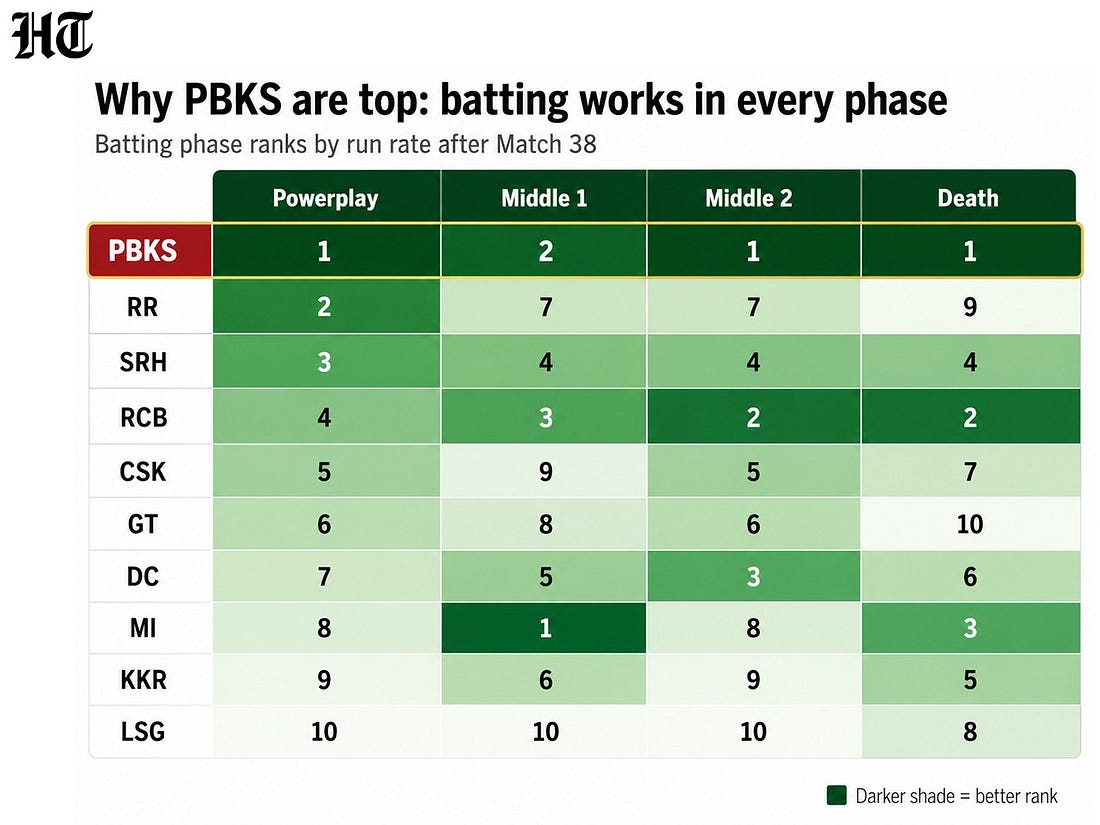
Punjab Kings are sitting at the top of the IPL 2026 standings after 38 matches. The table leaders do not own the Orange Cap. They do not own the Purple Cap. They have not built their campaign around one overwhelming superstar season. That should force a rethink of what is truly impactful this season. Their advantage sits deeper: batting spread, phase control and conversion. PBKS have created a scoring structure that keeps working from the powerplay to the death overs, making them more dangerous than teams with cleaner individual leaders.
Structure > SuperstarThe points table is just the starting point, not the full explanation. Punjab Kings being at the top after 38 matches tells us they have converted their strengths better than the rest. The more important question is how they have done it. The answer is batting spread. PBKS have not needed one batter to own the run-chart because their scoring has arrived in layers. Priyansh Arya has given them early acceleration. Prabhsimran Singh has supplied top-order muscle. Shreyas Iyer has added a rare combination of average, tempo and leadership. Their batting order has not been built around one batter absorbing pressure while the rest orbit him.
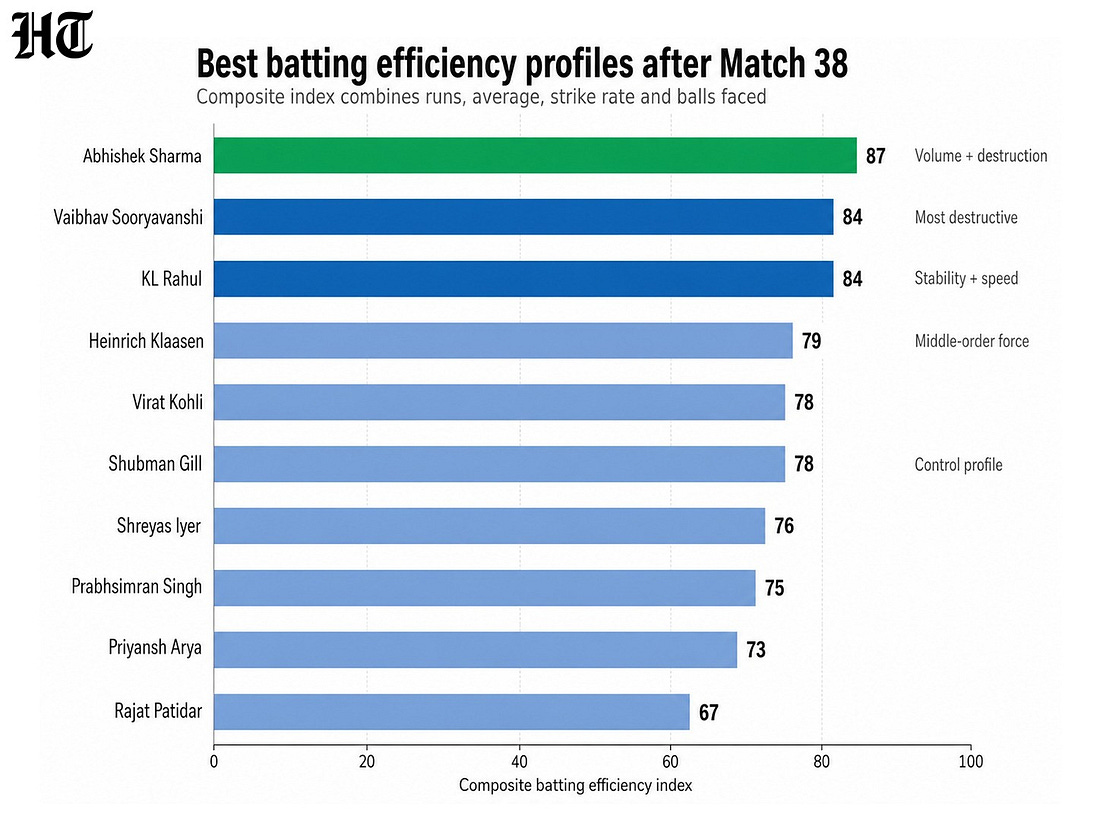
T20 cricket punishes single-point dependency. A team can have the season’s best individual batter and still lose if the rest of the batting unit collapses around him. PBKS have avoided that pattern better than most sides so far. Their batting is effective across phases. They have had powerplay thrust, middle-over continuity and death-over finishing. This is why their table position makes sense even without an Orange Cap leader. A normal leaderboard might miss that. A phase-led reading does not. Efficiency needs perspectiveStrike rate remains the loudest batting number in T20 cricket. It is also one of the easiest numbers to misuse. A batter scoring at 210 is not automatically more efficient than one scoring at 185 if the first batter has a much weaker average or lower match responsibility. T20 efficiency has to combine four things: runs, strike rate, average and role. That is why the strongest batting-efficiency case after 38 matches belongs to Abhishek Sharma.
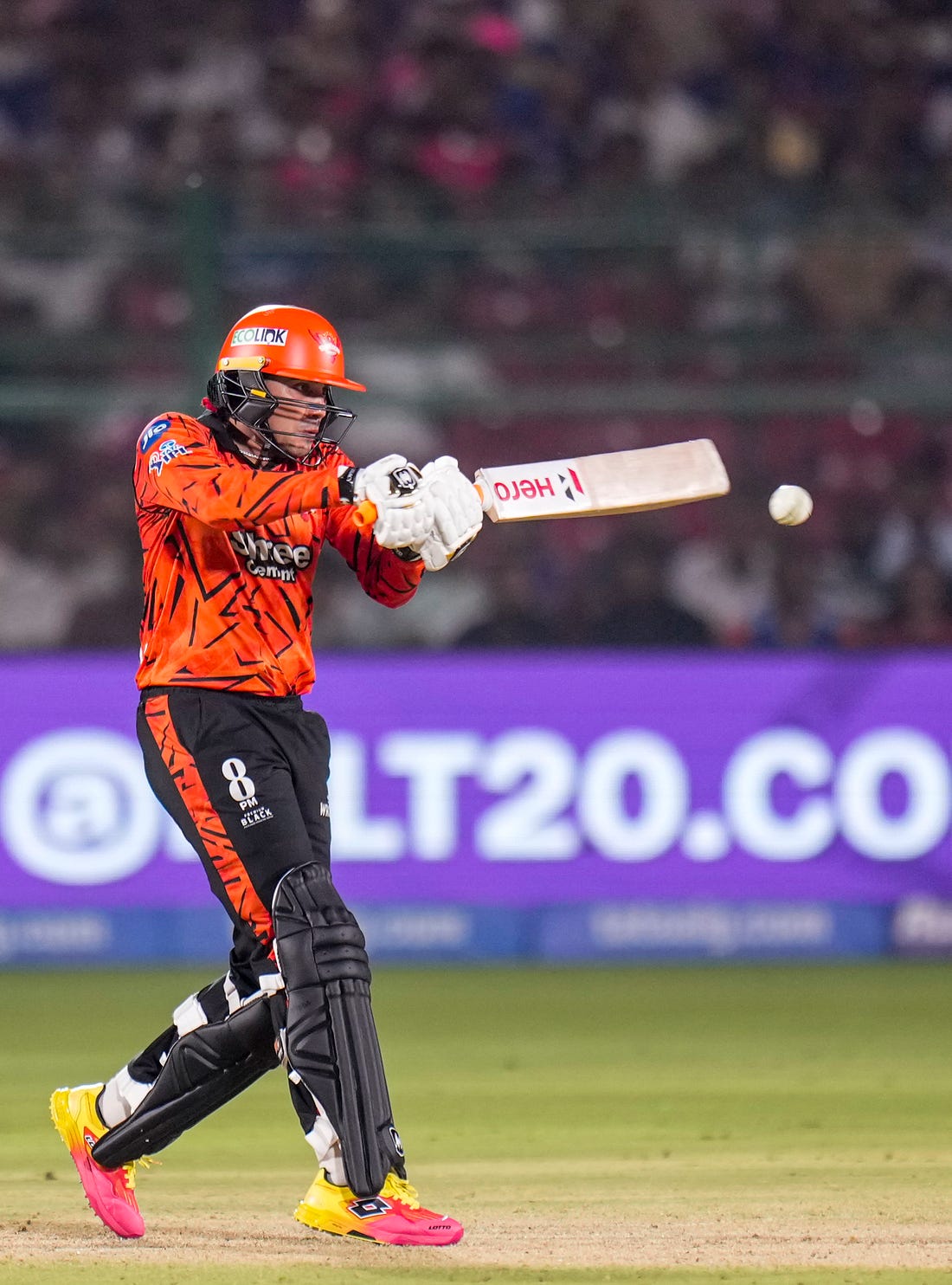
Abhishek Sharma led the run chart with 380 runs and did it at a strike rate above 212. That is the rare combination. He has not merely scored quickly, but scored quickly across enough volume to shape Sunrisers Hyderabad’s season. That separates him from smaller-sample hitters. A short burst can create a glamorous strike rate. Sustained high-speed volume is different. It forces opposition plans to change across matches, not just across overs. Abhishek’s value sits in that repeatability. He has given SRH both a ceiling and consistency. That is why he stands at the top of the batting-efficiency argument.
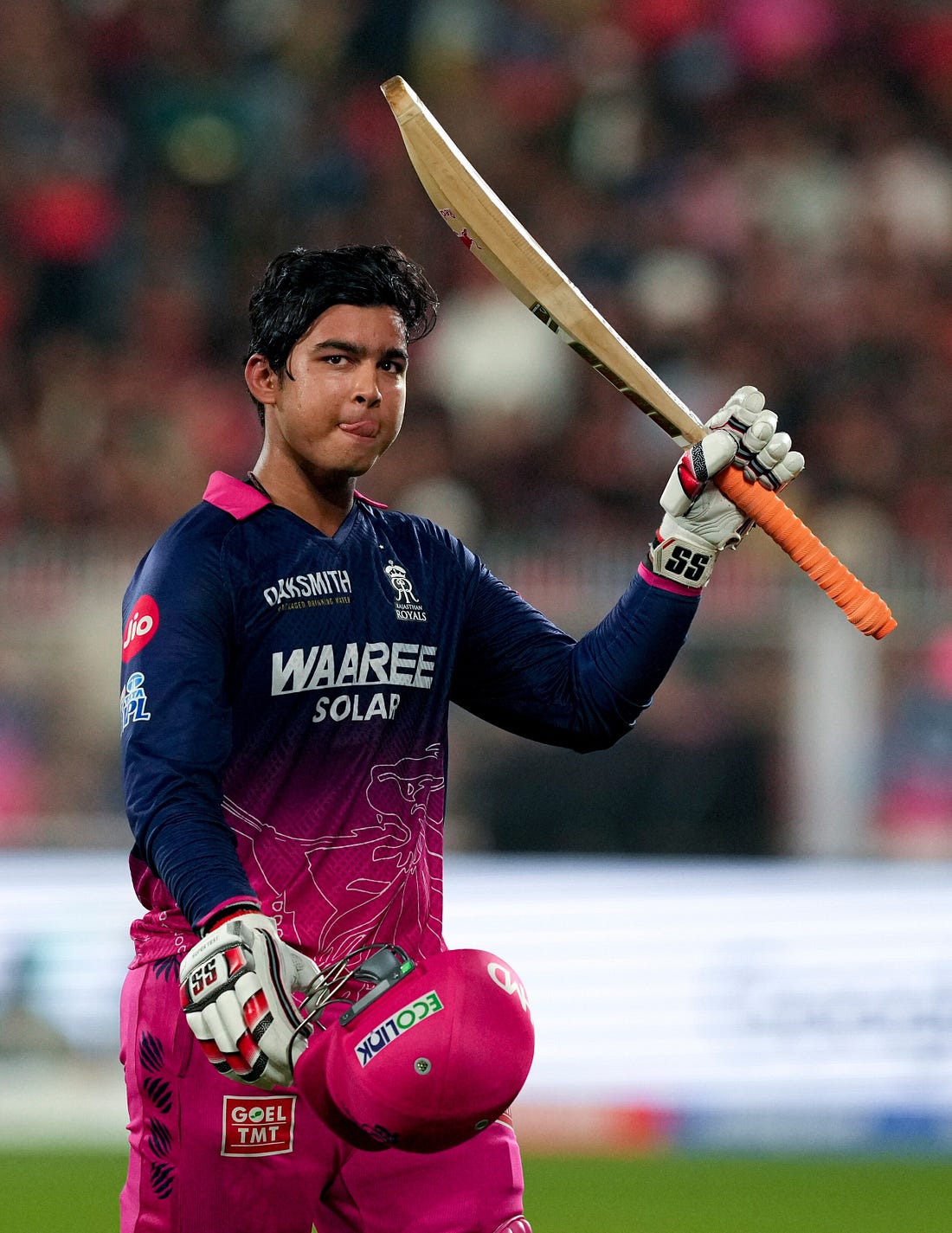
The biggest damage engineVaibhav Sooryavanshi’s numbers demand a different label. He is the most destructive batter of the season so far. His 357 runs at a strike rate above 234 have stretched the scale of what normal acceleration looks like. He does not just score quickly. He compresses innings. For Rajasthan Royals, that has enormous tactical value. A batter striking at that rate changes how opponents use their best bowlers. Captains are forced to defend earlier. Bowlers lose their margin. Field settings become reactive.
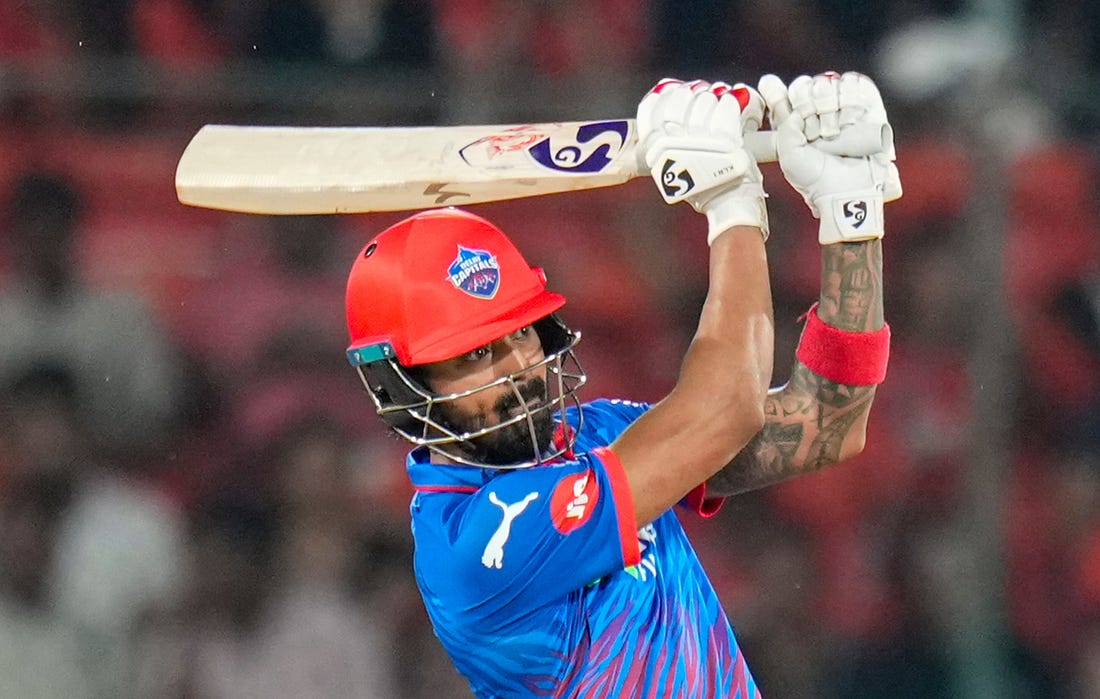
But destruction and complete efficiency are not identical. Abhishek has a stronger volume-plus-run-chart case. KL Rahul has a stronger stability-speed case. Vaibhav’s edge is pure damage. That is still an elite category. In fact, it may be the most frightening category for opposition teams. But the distinction matters. He is the most explosive batter in the league. Abhishek remains the stronger all-round efficiency pick. Stability still mattersKL Rahul’s season is important because it stops the analysis from becoming only about strike-rate extremes. His 357 runs at a strike rate close to 188 (till match 38) are high-class T20 numbers. In most seasons, that strike rate would be viewed as elite aggression. In IPL 2026, it risks being made to look ordinary because Abhishek and Vaibhav have pushed the top end so far. But considering it ordinary would be a mistake.
Rahul has carried major batting responsibility for the Delhi Capitals. His value comes from the blend: volume, control and pace. He has not been a slow anchor. He has been a high-output batter operating with stability. DC have not had the same batting spread as PBKS or SRH. In a less stable batting unit, a player who can make big runs at nearly 188 becomes structurally vital. Efficiency is not only about how quickly a batter scores in his best 20 balls. It is also about how often he gives his team a usable innings without dragging the scoring rate down. Rahul clears that test. Orange Cap doesn’t mean ‘Best Batter’The top run band after 38 matches gives five different batting stories.
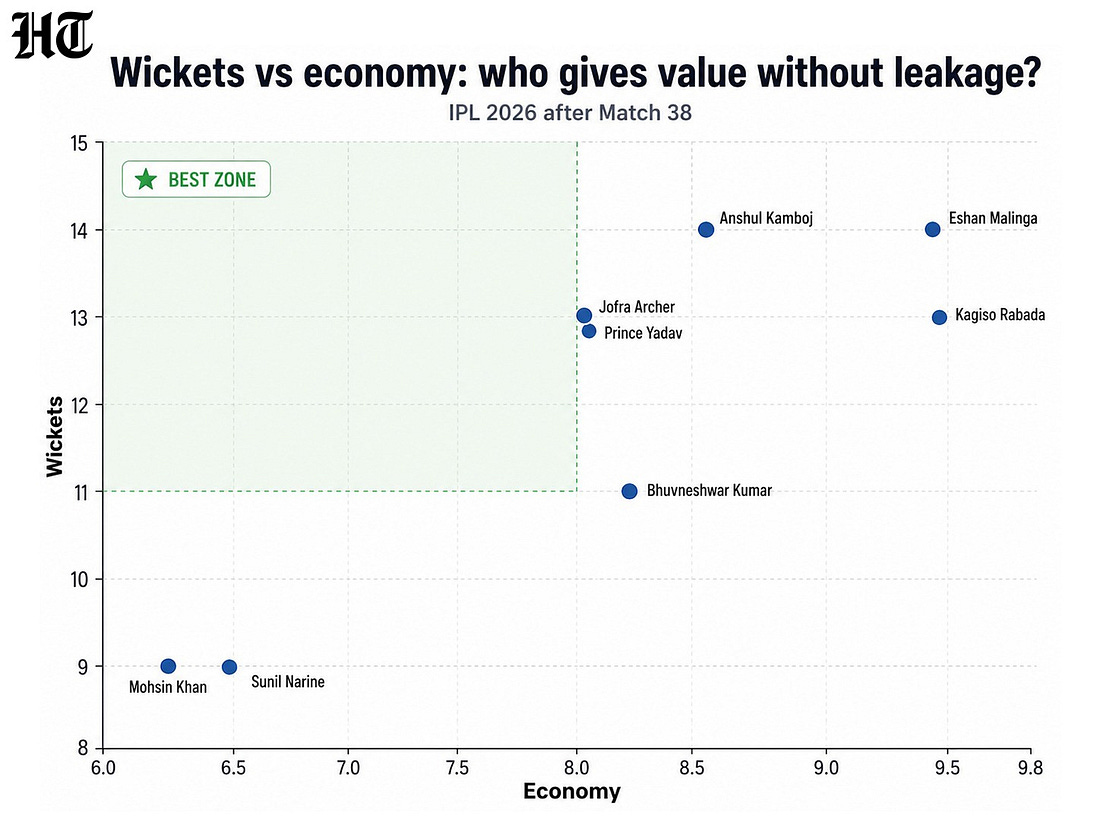
A simple run chart cannot separate those roles. It can only show volume. That is why a proper efficiency reading must ask how the runs were made. Top-order runs are not the same as finishing runs. A 45 off 22 in the powerplay has a different tactical effect from 45 off 22 at the death. A 70 that holds together a weak batting card may be more valuable than a faster cameo in a dominant batting unit. This is also why PBKS are such an important team in this analysis. Their batting strength is not concentrated in one Orange Cap candidate. It is distributed across roles. That distribution has made them harder to plan against. Stop one batter, and another phase still survives. That is a stronger league-stage model than dependence on one runaway scorer. Bowling efficiency isn’t ‘Purple Cap’ eitherThe same logic applies to bowling. After 38 matches, Anshul Kamboj and Eshan Malinga were at the top end of the wicket race with 14 wickets each. Jofra Archer, Prince Yadav and Kagiso Rabada were also in the leading group. The wicket chart matters. It always will. Wickets are the biggest currency in T20 cricket because they break intent, expose new batters, and shift the resource pressure. But wickets alone do not decide bowling efficiency.
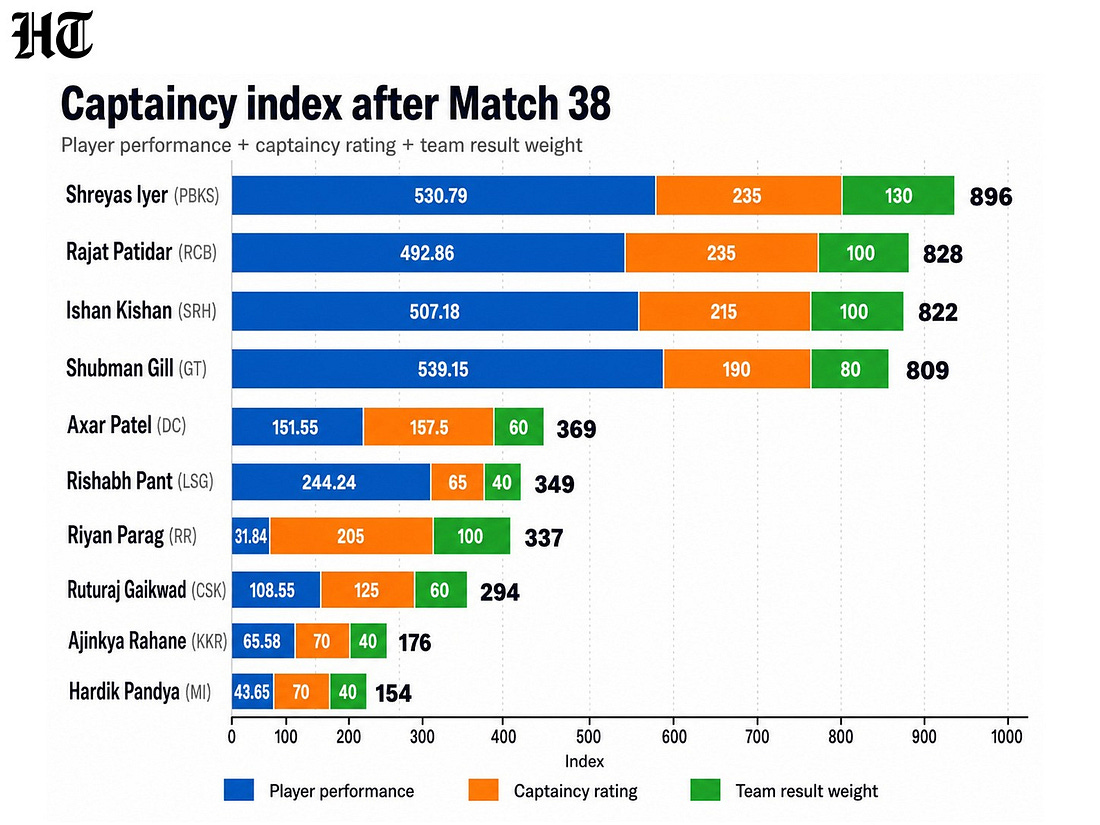
A bowler taking 14 wickets while going at 9.4 an over is not offering the same value as a bowler taking 13 wickets while operating around eight an over. Both are valuable. They are not the same kind of valuable. That is where Jofra Archer and Prince Yadav become important. They sit in the high-volume wicket-taking group while also offering stronger economy control. Kamboj’s wicket volume gives him the lead in the wicket story. Archer and Prince press harder in the efficiency story. Malinga’s case is slightly different. He has clear wicket-taking value and pressure impact, but his economy drag has to be factored in. Ignoring that would be the same mistake as judging a batter only by strike rate. Shreyas Iyer has the strongest captaincy caseCaptaincy has to be judged separately from player performance, but it cannot be detached from results. That is why Shreyas Iyer has the strongest captaincy case after 38 matches. Punjab Kings are at the top. His own batting has added real value. His leadership rating sits in the top tier. The team’s strongest identity, its batting structure, has operated with clarity under him. That creates a cleaner captaincy argument than a raw leadership score alone.
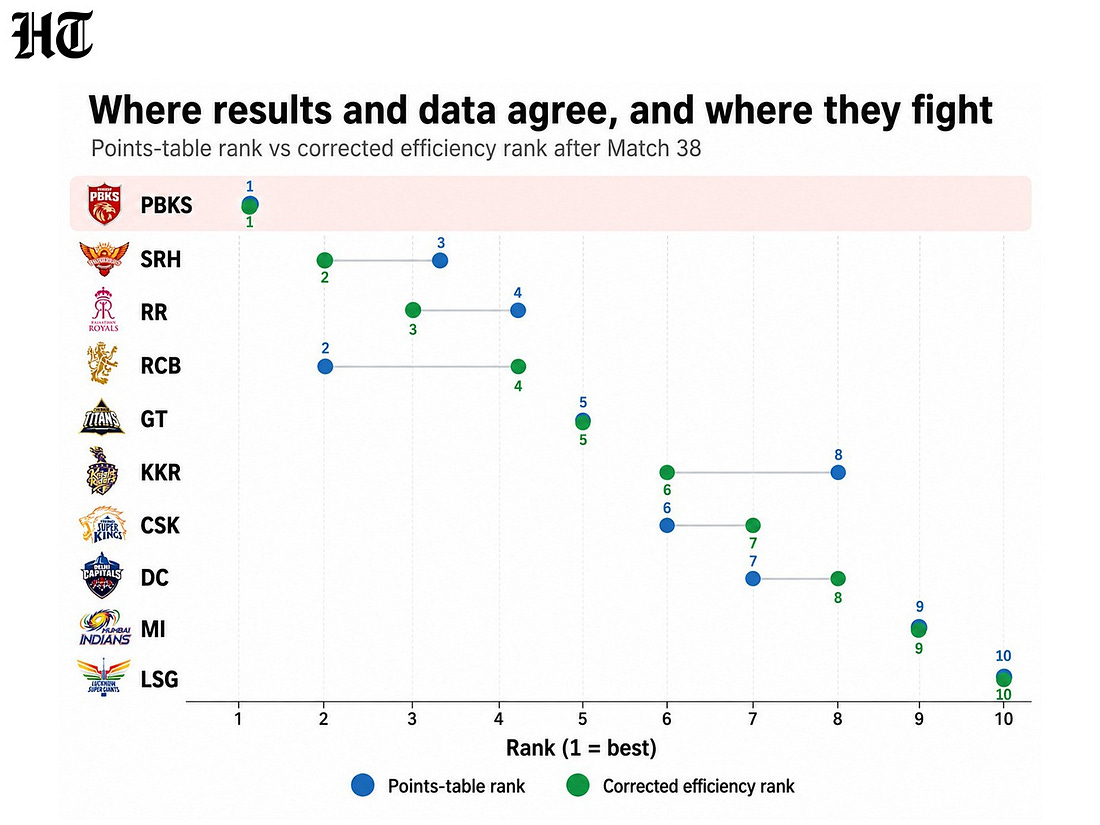
Rajat Patidar also belongs in the top conversation. His batting tempo and captaincy value have helped RCB stay in the leading group. Ishan Kishan deserves credit for SRH’s all-round strength. But Iyer’s case is backed by the table in a way the others cannot fully match. One particular correction is important because captaincy should not cover poor player performance too easily. A captain can have strong tactical games and still not be the best captain-player package if his own contribution is weak. Leadership adds value. It does not erase batting or bowling failure. The corrected team pictureThe strongest team by results and batting structure is the Punjab Kings. The strongest all-round profile belongs to Sunrisers Hyderabad. They have the top run-scorer in Abhishek, a major middle-order force through Klaasen, and wicket-taking value through Malinga. Rajasthan Royals carry the most destructive batting weapon in Vaibhav and a strong bowling spine through Archer and their spin options.
RCB remain in the top group because their batting has enough late-overs punch, and Patidar’s captaincy-player value keeps them competitive. GT look steady rather than explosive, built around Gill’s control and a bowling group with wicket-taking ability. KKR have fielding quality and clutch value, but their position shows those strengths have not yet become a complete campaign. CSK have Kamboj’s wicket-taking season but need more collective force. DC have Rahul’s runs but not enough batting spread. MI and LSG have had individual pockets of value, but not enough conversion. That hierarchy is important because it separates component strength from team strength. Some sides have excellent pieces. PBKS have built the best working machine so far. The efficiency verdictThe first 38 matches of IPL 2026 have made one point clear: efficiency cannot be read from one column. Abhishek Sharma is the best case for batting efficiency because he combines volume and extreme scoring speed. Vaibhav Sooryavanshi is the most destructive because his strike rate has changed the scale of acceleration. KL Rahul remains one of the most valuable because his runs combine pace with stability. Anshul Kamboj leads the wicket story, but Jofra Archer and Prince Yadav strengthen the bowling-efficiency debate through economy control. And Shreyas Iyer has the strongest captaincy case because performance, leadership and the points table are aligned. Punjab Kings are the centre of the season’s first major data lesson. They are not the top because they dominate every individual leaderboard. They are at the top because their batting efficiency has become team efficiency. Thanks for reading! Subscribe for free to receive new posts from CRICKIT BY HT.
|








0 टिप्पणियाँ: